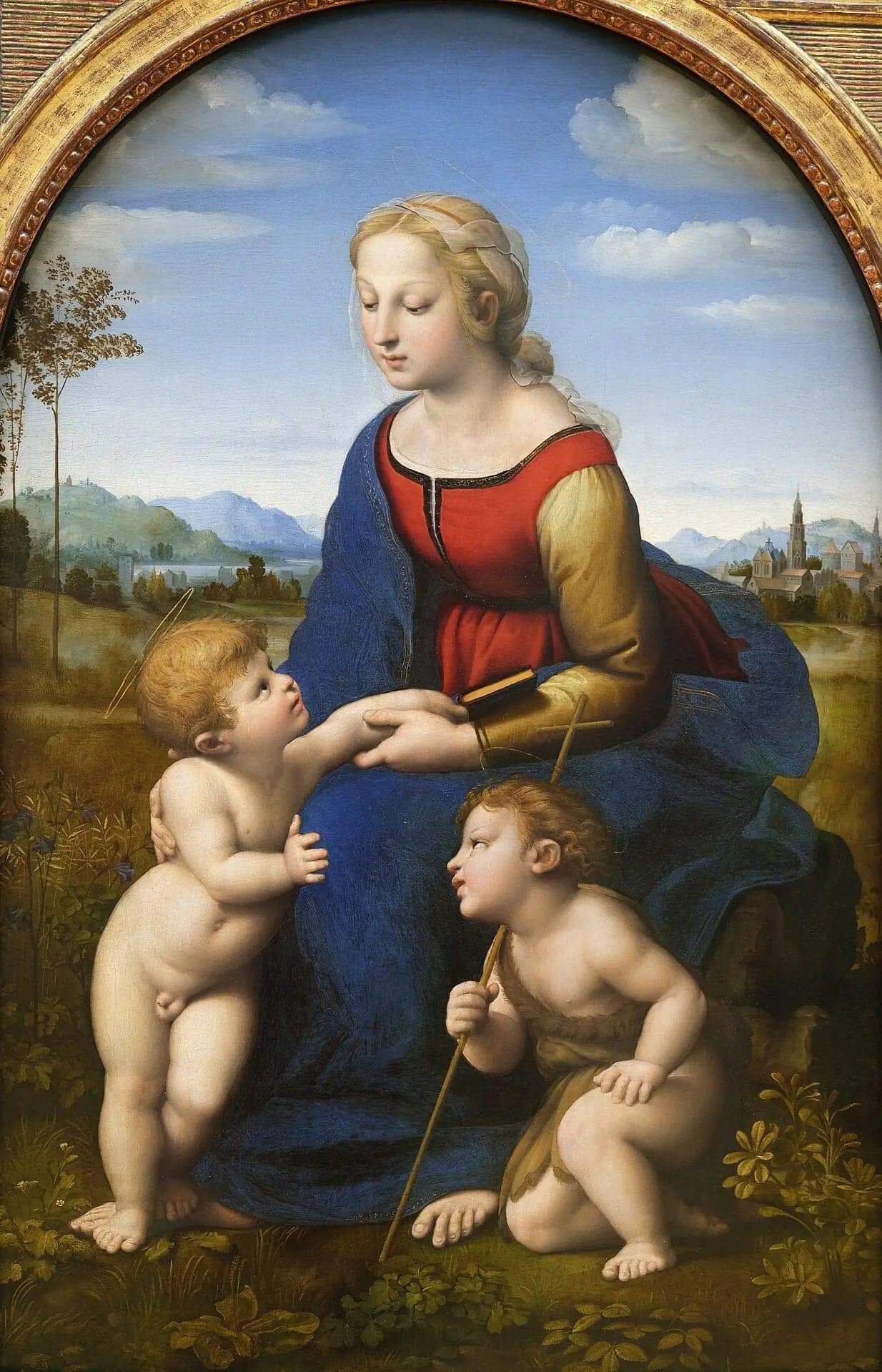
The Beautiful Gardener
- Original dimensions
- 80 x 122 cm
- Movement
- High Renaissance
- Museum
- room 710
- Year
- 1500
Scene depicted
In this painting, Raphael conveys the tenderness of a mother, surrounded by the golden light of the sun, gently caressing her child's face. This painting illustrates the harmony of human relationships, highlighting nature as a symbol of fertility and peace. The vibrant colors and refined details invite deep reflection on the sacred bond between mother and son, capturing a moment suspended in time.
Historical context
Created in 1500, The Beautiful Gardener is emblematic of the High Renaissance , a movement that flourished in the shadow of Florentine masterpieces. It was in Florence, a city still resonating with the echoes of the genius of Michelangelo and Leonardo da Vinci, that this painting was born. Today, the painting is located in room 710 of a museum that celebrates art in all its forms, captivating visitors with its timeless brilliance.
Place in the artist's career
The Beautiful Gardener stands as a pinnacle in Raphael's career, revealing his mature style and unparalleled mastery of chiaroscuro. By this time, he had already created other masterpieces such as The Sistine Madonna and The Virgin with Chancellor Rolin, where one can observe a striking evolution in the use of space and figures. This canvas embodies the moment when his art reaches a spiritual and emotional depth that continues to inspire.
Anecdote
“Beauty lies in simplicity, and nature is our greatest teacher.” Thus spoke Raphael one spring morning in the heart of Florence, as he crossed the gaze of a mother cradling her child in a garden. This simple act of love inspired a timeless work that breathes sweetness and serenity, transforming The Beautiful Gardener into a canvas imbued with strong emotions.