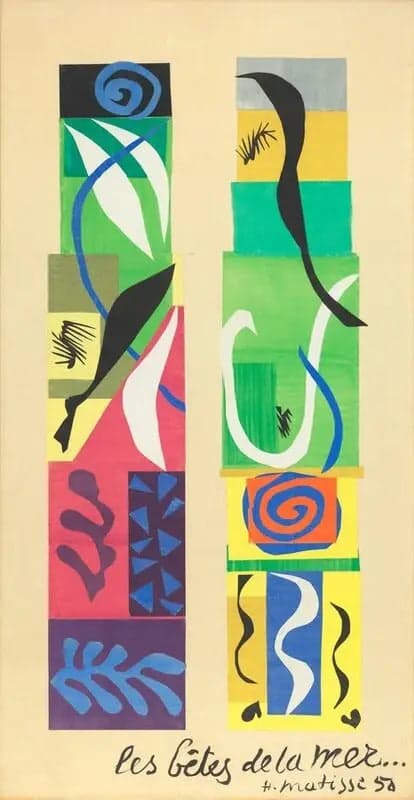
The Beasts of the Sea
- Original dimensions
- 154 x 295.5 cm
- Museum
- National Gallery of Art
- Year
- 1950
Scene depicted
In this vibrant painting, Matisse embraces the sea while playing with voluptuous shapes and bold colors. The marine creatures, with their sinuous silhouettes, seem to dance in the waves of a playful sea. The canvas evokes an aquatic universe that is both playful and mysterious, an echo of nature. The Beasts of the Sea immerses us in the heart of an imaginary world where daydreaming meets reality.
Historical context
Created in 1950, during a vibrant period in art history, the painting The Beasts of the Sea belongs to the Fauvist movement, which flourished in Paris, the cradle of artistic avant-garde. This iconic work is now preserved at the National Gallery of Art , a temple dedicated to the preservation of global masterpieces. With its majestic dimensions of 154 x 295.5 cm, this canvas asserts itself through its presence and vitality.
Place in the artist's career
The Beasts of the Sea represents a high point in Matisse's career, a period when he asserts himself as a master of color and form. Compared to other works such as The Dance and The Joy of Life , this canvas illustrates his ability to merge abstraction and representation. This masterpiece testifies to his evolution towards a freer abstraction, where expression takes precedence over appearance.
Anecdote
Henri Matisse once stated: "Color is a cry." This quote perfectly illustrates the essence of his work. Inspired by a bright morning by the Mediterranean Sea, he captured not only the beauty of the landscape but also the energy and movement, like a dreamlike dance of sea creatures. It is this initial emotion that gives The Beasts of the Sea its evocative power.