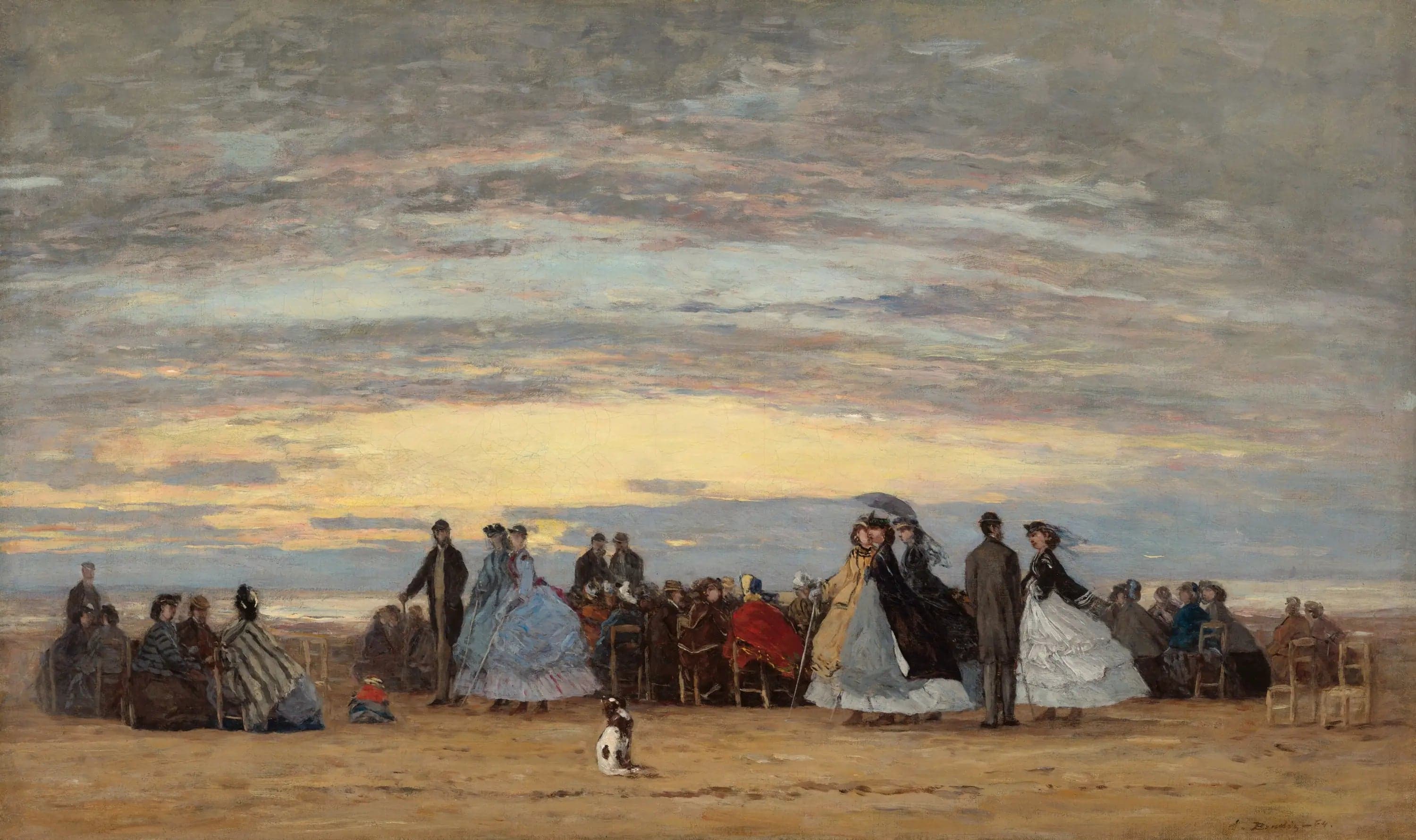
The Beach at Villerville
- Original dimensions
- 76.3 x 45.7 cm
- Museum
- National Gallery of Art
- Year
- 1864
Scene depicted
In this canvas , Boudin depicts a vibrant beach scene, where holidaymakers enjoy the last rays of sunshine. The composition reveals a dialogue between the sea and the sky, evoking the simple pleasures of seaside life. The white sails mingle with various silhouettes, capturing the spirit of a Norman summer.
Historical context
Created in 1864, The Beach at Villerville is rooted in the beauty of this small seaside town in Normandy, a symbol of the Impressionist movement that was emerging at the time. This painting, which captures the brilliance of light on the Normandy shores, is now housed in the National Gallery of Art , thus preserving a precious link with the artistic history of that era.
Place in the artist's career
The Beach at Villerville marks a turning point in Boudin's career, illustrating his innovative style. Alongside La Trouville, 1869 and The Beach of Deauville, 1888 , this painting shows how Boudin was able to evolve, both through his use of light and his ability to convey emotions through painting .
Anecdote
“I want to paint the world as it is, without artifice, under the light of day,” said Eugène Boudin , while walking on the beach, inspired by the gentle murmur of the waves and the play of shadows on the warm sand. This ephemeral and natural moment resonates powerfully in the painting that delivers a lively scene of joy and serenity.