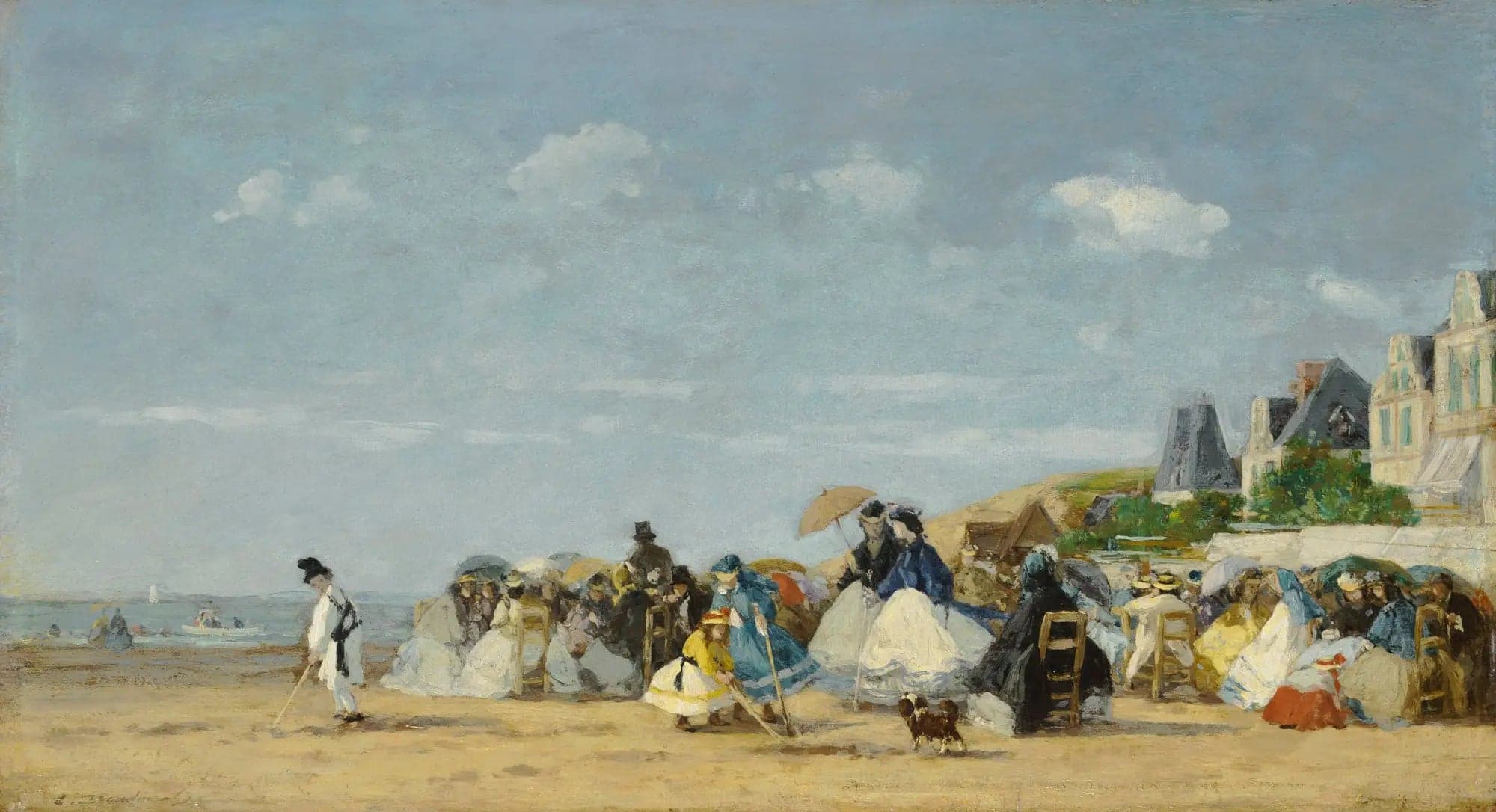
The Beach at Trouville
- Original dimensions
- 89 x 63 cm
- Museum
- National Museum of Western Art
- Year
- 1867
Scene depicted
In the painting “The Beach of Trouville,” Boudin captures a vibrant and lively scene, where the sea, bathers, and white sails blend gracefully. The colorful figures come alive on the golden sand, while the sky evokes promises of escape and freedom. Each brushstroke pays tribute to the natural beauty of this idyllic place, transporting the viewer to moments of joy and conviviality by the sea.
Historical context
Created in 1867, this painting emblematic of Eugène Boudin is rooted in the seaside landscape of Trouville-sur-Mer, a popular resort in Normandy. This canvas is part of the Impressionist movement, foreshadowing the trends that would mark the end of the 19th century. Now exhibited at the National Museum of Western Art , this painting reveals the dimensions of an era where nature and leisure inhabited the daily lives of emerging societies.
Place in the artist's career
This painting represents a turning point in the career of Eugène Boudin , an artist in full metamorphosis. Between his early intimate works and his monumental achievements like “The Port of Honfleur” and “The Rising Sun,” “The Beach of Trouville” stands as a crucial link between his fields of expression and his explorations of light. Here, he marries technique with the marine landscape, establishing a dialogue between sky and sea.
Anecdote
“True beauty is found where one least expects it, by the water's edge, under the changing sky,” said Eugène Boudin one summer morning. It was amidst the small waves and children's laughter that he discovered the essence of his masterpiece , capturing the golden light of a simple yet fascinating day. This painting tells the vastness of the sea through the eyes of an artist in love with sensations.