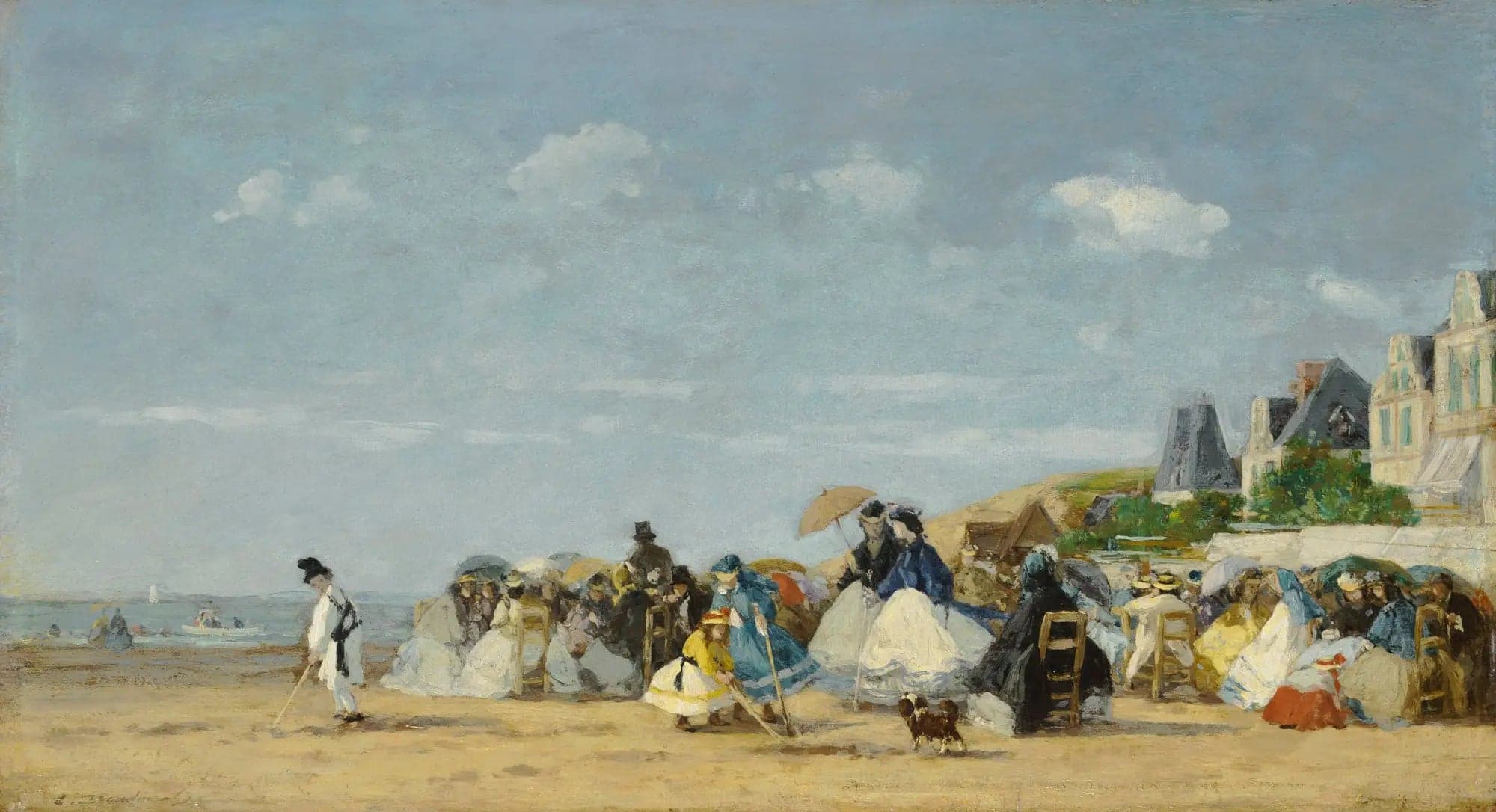
The Beach at Trouville
- Original dimensions
- 62.8 x 38 cm
- Museum
- Princeton University Art Museum
- Year
- 1865
Scene depicted
This canvas depicts a lively and animated scene, where vacationers gather on the golden sand. The white sails of boats in the distance stand out against an ethereal blue sky. Boudin knows how to play with light, allowing an atmosphere of joy and freedom to emerge, characteristic of sunny days on the beach of Trouville. It is a work that transcends time and invites us to discover the simple beauty of outdoor life.
Historical context
Created in 1865, this painting is set in the picturesque backdrop of Trouville-sur-Mer, a popular French seaside resort during the 19th century. Eugène Boudin , a precursor of impressionism , captures here the essence of a time when light and nature intertwine with infinite delicacy. Currently, this canvas rests precious in the collections of the Princeton University Art Museum , measuring 62.8 x 38 cm, testifying to the artistic craftsmanship of the era.
Place in the artist's career
The painting The Beach at Trouville represents a turning point in Boudin's career, marking a period of maturity and full expression of his style. Like The Entrance to the Port of Le Havre (1867) and The Landing of Fishermen at Trouville (1869), this canvas highlights the evolution of his techniques, merging the impression of movement and the delicacy of light.
Anecdote
“The sea, the light, and the people on the beach speak to me in a way that I try to immortalize on my canvas.” One radiant morning, by the sea, the golden light reflects in the waves, inspiring Boudin to capture this fleeting moment of life. It is this moment of connection between the artist and nature that imbues each brushstroke of his painting .