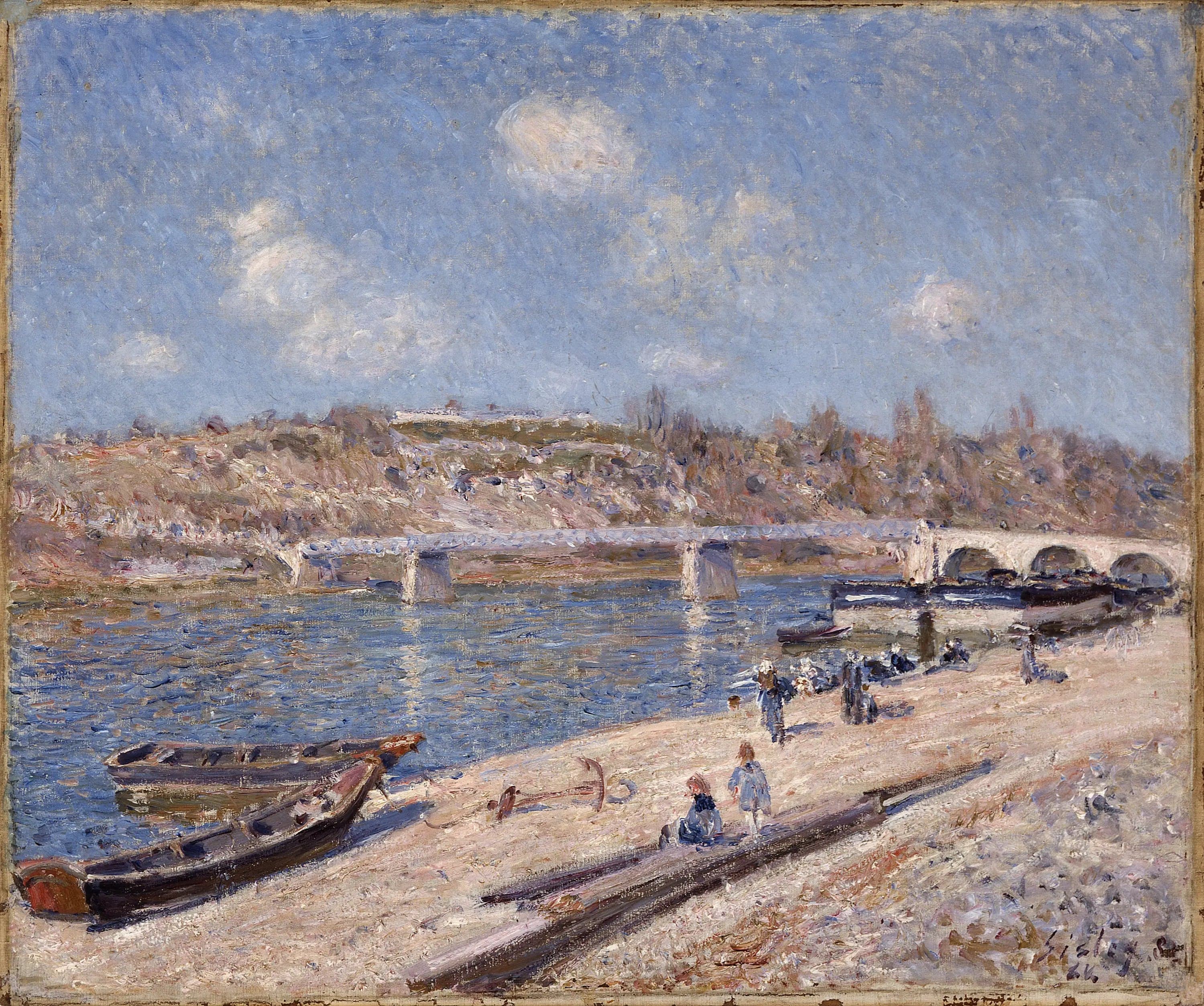
The Beach at Saint-Mammès
- Original dimensions
- 62.2 x 51.8 cm
- Museum
- Saint Louis Art Museum
- Year
- 1884
Scene depicted
The canvas “The Beach at Saint-Mammès” illustrates a peaceful and charming scene, where bathers bustle on the shore of a lively beach. The meticulous details of the figures, the fluidity of the movements, and the animation of the light evoke the sweetness of a summer afternoon. Sisley succeeds in capturing the essence of a fleeting moment, making each glance at this painting memorable.
Historical context
Created in 1884, this painting is emblematic of the Impressionist movement, at a time when artists sought to capture natural light and everyday life. Alfred Sisley , a recognized landscape painter, chose the charming village of Saint-Mammès, located by the Seine, as his backdrop. Today, this canvas is carefully preserved at the Saint Louis Art Museum, a perfect setting for this pictorial work inviting contemplation.
Place in the artist's career
This painting stands as an important milestone in Sisley's career, marking his stylistic development within Impressionism . Compared to Monet's “Impression, Sunrise” and Manet's “Luncheon on the Grass,” it demonstrates a technical evolution towards a more personal expressiveness, while preserving the spirit of the movement.
Anecdote
“I love to see nature in its simplest expression, when it dances under the golden rays of the sun.” This quote perfectly summarizes the mindset with which Sisley approached the creation of this masterpiece . Imagine him, sitting on the shore, listening to the gentle murmur of the waters and feeling the soothing scent of spring. It is this deep connection with his environment that brings The Beach at Saint-Mammès to life.