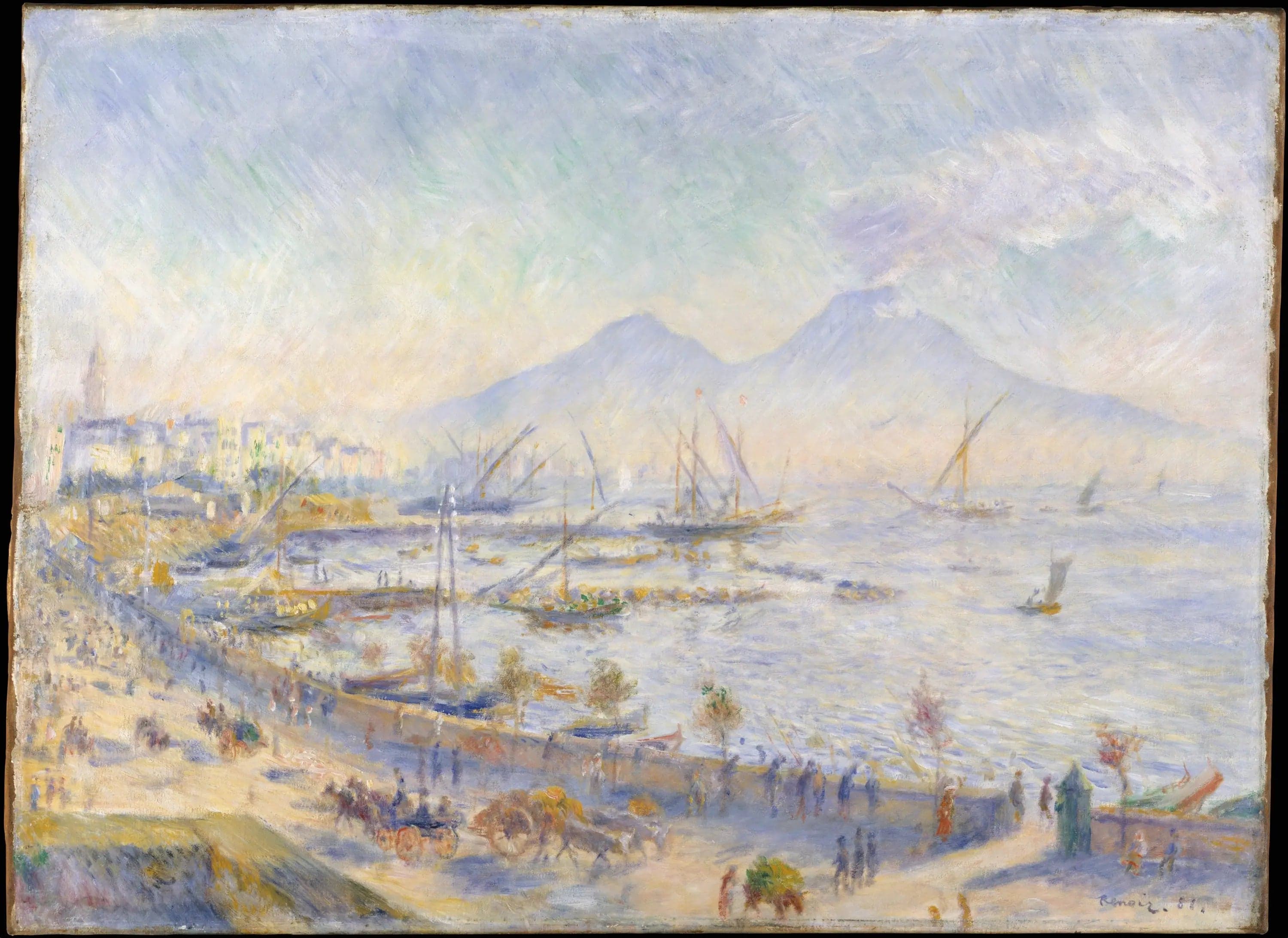
The Bay of Naples - Pierre
- Original dimensions
- 81.3 x 59.7 cm
- Museum
- Metropolitan Museum of Art
- Year
- 1881
Scene depicted
This canvas finely illustrates the splendor of the Gulf of Naples, where fishing boats gently sway on turquoise waters, while Vesuvius majestically rises, adorned with a sky of azure blue. The work depicts a living tableau, where light plays an essential role, revealing the perfect harmony between nature and humanity.
Historical context
Created in 1881, The Bay of Naples is set in the sunny backdrop of the Neapolitan coast, a region rich in history and colors, as interpreted by the Impressionist movement. This iconic painting, now housed at the Metropolitan Museum of Art in New York, invites the viewer to discover the vibrant reflections of delicate light and the nuances of nature, while capturing the very essence of a flourishing era.
Place in the artist's career
The Bay of Naples represents a mature period for Renoir, illustrating his evolution towards bolder compositions. At this time, works such as Lunch of the Boaters and Parisians at the Bank also testify to his masterful use of light and color. This painting thus stands as an important milestone in his career, a fusion between Impressionism and pictorial lyricism.
Anecdote
“There is nothing more ephemeral than light. My desire is to capture it in my canvases.” This quote, emblematic of Renoir, evokes the moment when the artist, faced with the beauty of the Bay of Naples, felt an irresistible need to compose this masterpiece . It was on a gentle morning, cradled by the song of the waves, that the magic of this painting came to life.