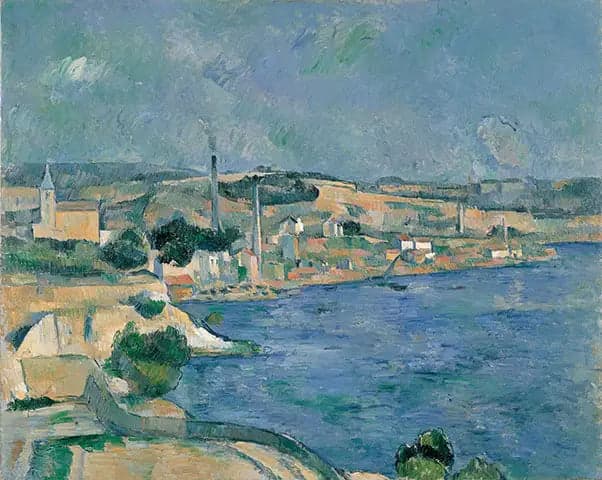
The Bay of Marseille, with a view of the village Saint-Henri near l'Estaque
- Original dimensions
- 83 x 66.5 cm
- Museum
- Yamagata Art Museum
- Year
- 1877
Scene depicted
This striking painting depicts the majestic bay of Marseille, illuminated by a gentle breeze and bathed in the golden light of a summer afternoon. The village of Saint-Henri stretches across the canvas, vibrating under shades of blue and ochre, evoking a peaceful, almost meditative atmosphere, where the sea merges with the sky into a distant horizon. Each brushstroke testifies to the artist's mastery and his love for this unique landscape.
Historical context
Created in 1877, this iconic work by Paul Cézanne perfectly illustrates the soul of Provence, Marseille, and the beauty of the village of Saint-Henri, nestled near l'Estaque. The painting is part of the Impressionist movement, evolving towards a unique representation that marks a turning point in the history of art. Today, this canvas rests at the Yamagata Art Museum, where it continues to move visitors with its captivating dimensions.
Place in the artist's career
The Bay of Marseille , although created quite early in Cézanne's career, already represents a peak of his technical and emotional mastery. In parallel with other masterpieces like “The Large Bathers” and “Mont Sainte-Victoire,” this canvas illustrates an evolution towards geometric abstraction and depth of color, heralding the revolutions to come in the 20th century.
Anecdote
“I seek to capture the light that dances on the canvas and brings nature to life.” Such were Cézanne's words as he worked on his project in the heart of Provençal excitement. On a sunny morning, cradled by the song of cicadas and the scent of pines, he vibrates his palette, thus infusing a lively energy into this composition. This quote illustrates the passion that fueled the creation of The Bay of Marseille , his desire to convey a moment of grace.