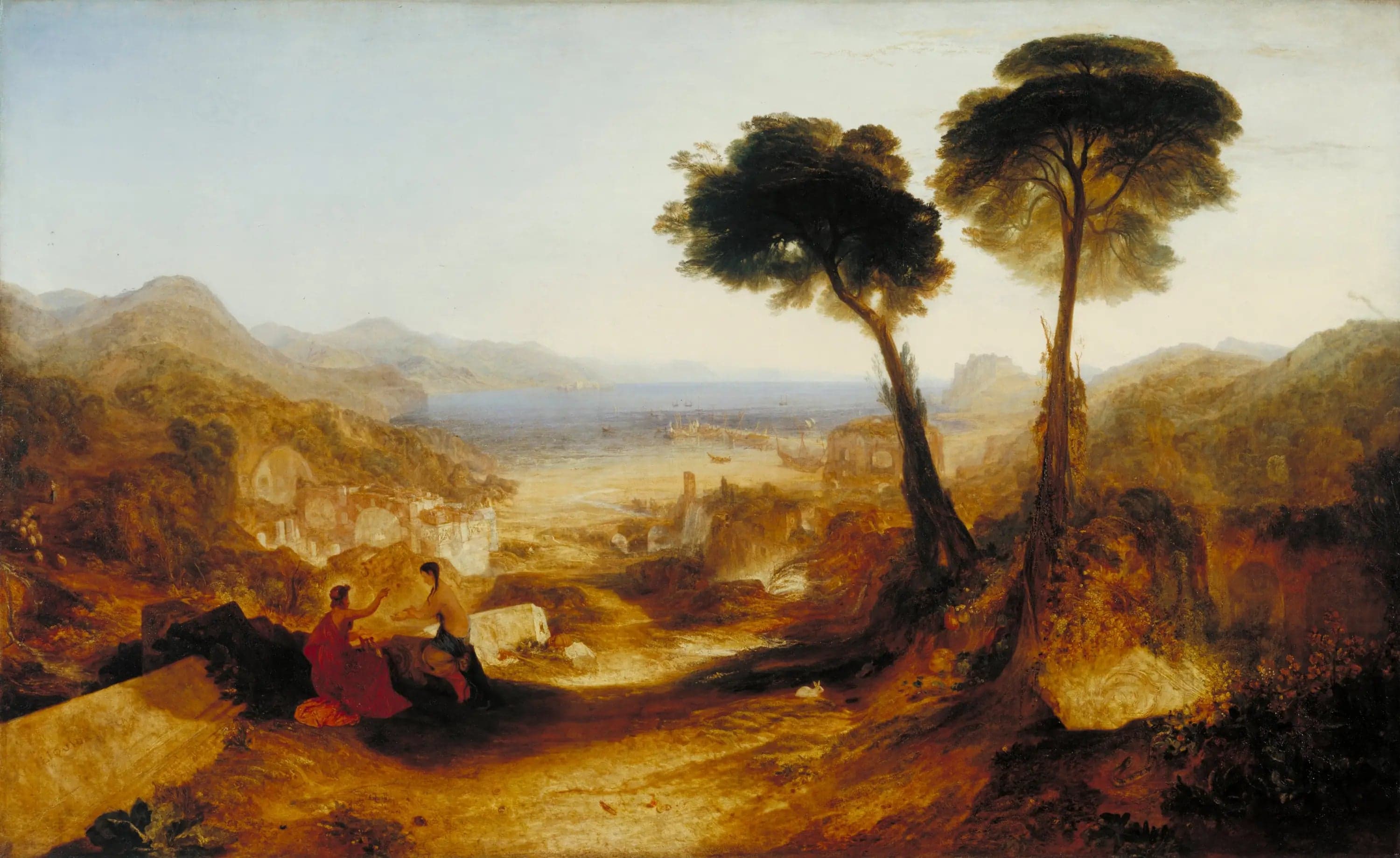
The Bay of Baiae, with Apollo and the Sibyl
- Original dimensions
- 145.4 x 237.5 cm
- Museum
- Tate Britain
- Year
- 1823
Scene depicted
The painting “The Bay of Baiae, with Apollo and the Sibyl” depicts a scene imbued with serenity where Apollo, the god of light, converses with the Sibyl, a fascinating prophetess. At the heart of this painting, the sea sparkles under a brilliant sky, while the mythological figures seem to vibrate with life and wisdom, symbolizing humanity's eternal quest for knowledge and beauty.
Historical context
Created in 1823, this painting is emblematic of the famous British artist Joseph Mallord William Turner and is set in the enchanting backdrop of Baiae, a famous seaside resort of ancient Rome, in Italy. Turner, a major figure of the Romantic movement, captures the essence of this era through his mastery and pictorial boldness. Currently on display at the Tate Britain, this work monumentalizes a mythological scene within a fascinating composition.
Anecdote
“Art must be an embrace of light and emotion.” In a burst of creativity, Turner is said to have been inspired by a rising sun at the edge of the sea, in the soothing silence of a spring morning, a vision that powerfully echoes his masterpiece . This painting evokes both the harmonious beauty of nature and the melancholy of mythological tales.