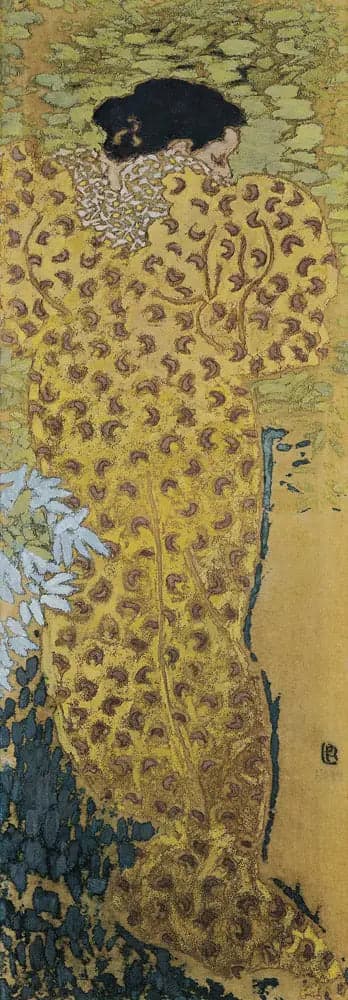
The Bathrobe
- Original dimensions
- 50 x 150 cm
- Museum
- Orsay Museum
- Year
- 1890
Scene depicted
"The Bathrobe" captures an intimate scene where a woman prepares in the softness of golden light. The warm palette and organic shapes evoke an atmosphere of serenity. The composition interweaves in a delicate play of shadows and light, suggesting an intimacy that is subtle, where every detail, from the bathrobe to the surrounding textures, seems to breathe the tranquility of the moment.
Historical context
Created in 1890 in Paris, the painting "The Bathrobe" is part of the Nabi movement, of which Pierre Bonnard is a member. This artistic movement emerged at the end of the 19th century, in response to Impressionism, seeking a more personal and symbolic expression. This canvas is currently displayed at the Orsay Museum , a prestigious setting for this work that measures 50 x 150 cm.
Place in the artist's career
This painting marks a significant milestone in Bonnard's career, paving the way for his mature aesthetic. Compared to "The Peach Harvest" and "The Two Sisters," "The Bathrobe" reveals a stylistic evolution where color and light take a predominant place, reflecting his journey towards a more personal and introspective expression in his creations.
Anecdote
“The truth is in the emotion, not simply in the form.” Pierre Bonnard is said to have felt this inspiration one spring morning while observing his partner in a moment of gentle intimacy, bathed in the soft light filtering through the curtains. This gave birth to a painting whose evocative power is directly linked to that fleeting and precious moment.