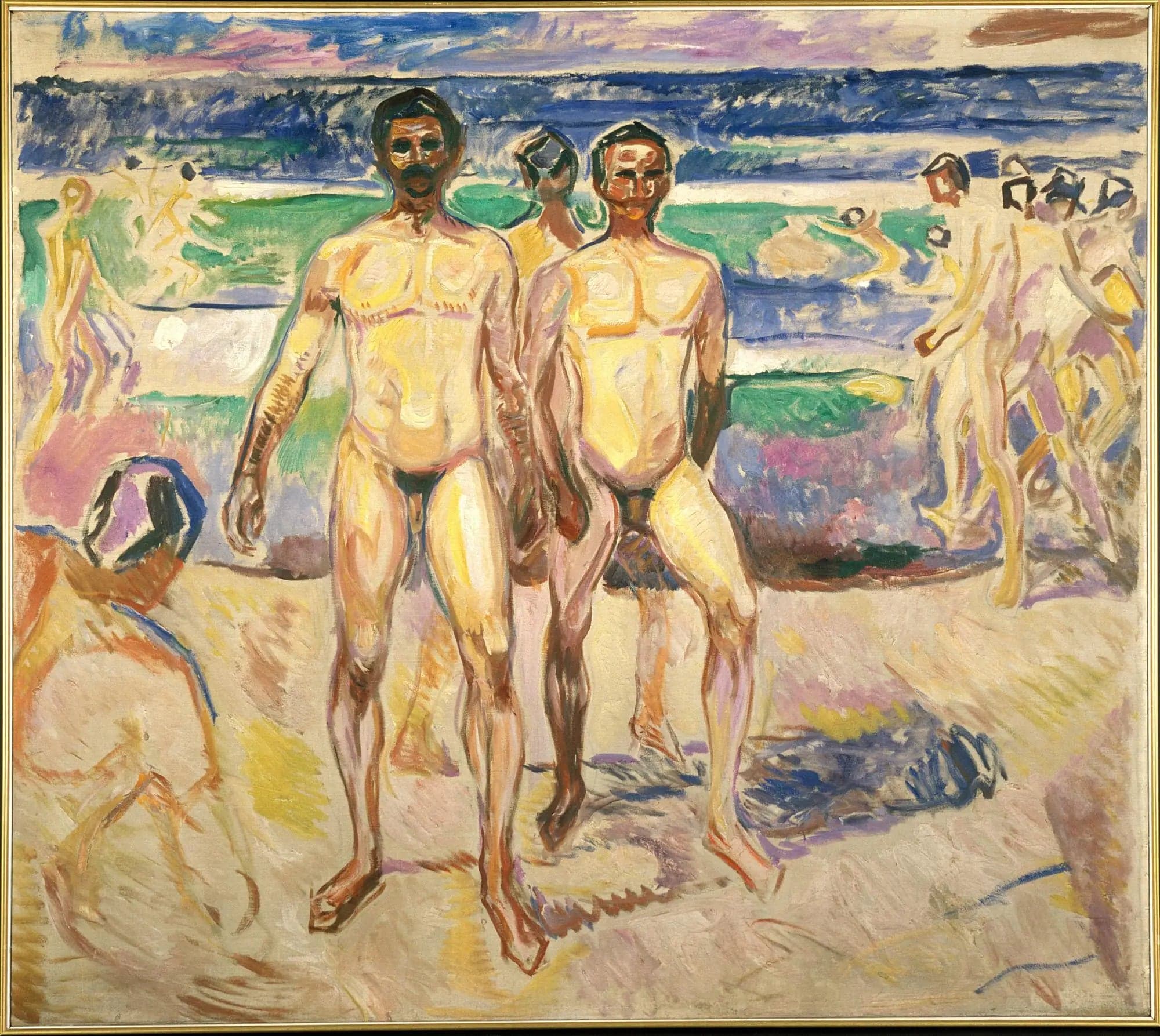
The Bathers
- Original dimensions
- 227.5 x 206 cm
- Museum
- Ateneum Art Museum
- Year
- 1900
Scene depicted
In The Bathers , Munch dives into both movement and emotion. This painting features male silhouettes, shadows and lights in an aquatic setting. Their interactions, both fleeting and eternal, evoke the suspended moments often found near water. The painting invites the viewer to question the relationship between man and nature, about shared intimacy.
Historical context
Created at the dawn of the 20th century, in a context of artistic and social upheaval, the painting The Bathers is part of the expressionist movement that embraces subjectivity. In Helsinki, at the Ateneum Museum, this work captured in 1900 reflects a changing world, where human emotions are liberated. The painting, with its impressive dimensions, evokes the quest for freedom through water, a vital and symbolic element.
Place in the artist's career
This masterpiece represents a key step in the evolution of Edvard Munch . After The Scream and Vampire , The Bathers reveals a lighter approach, where joy and irreverence contrast with the despair of some of his earlier works. It is a period of searching for light and composition, essential for grasping the entirety of his artistic journey.
Anecdote
Edvard Munch once confided: "Life is not only found in beauty, but in the sensations we derive from it." Inspired by a coastal summer, during an immersion in nature, he was able to powerfully convey the intensity of gestures at the heart of his composition . Each brushstroke resonates with the cries of the waves and the laughter of bathers.
Major exhibitions
Munch og Warnemünde: 1907-1908