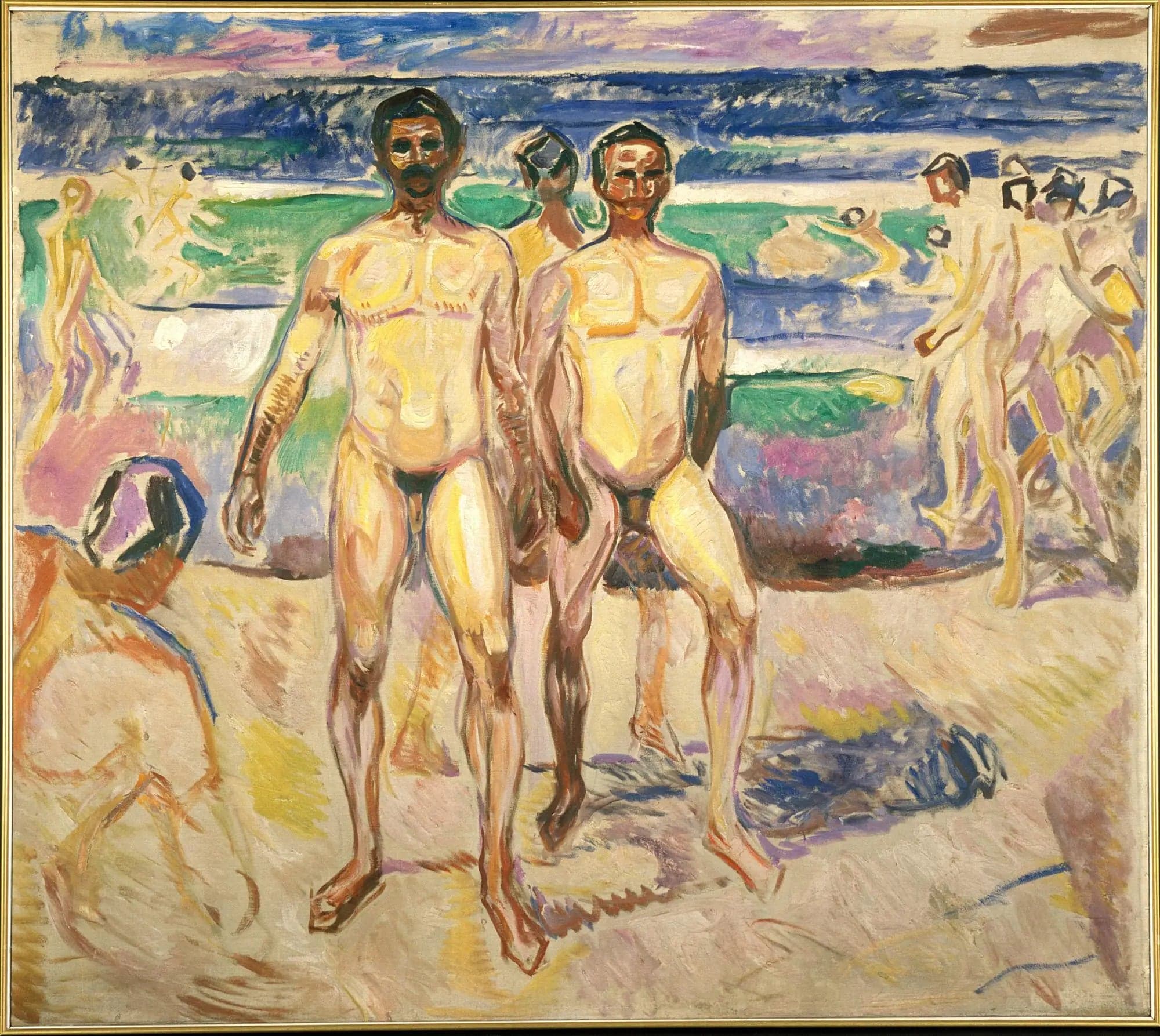
The Bathers
- Original dimensions
- 226 x 200.5 cm
- Museum
- Munch Museum
- Year
- 1913
Scene depicted
At the heart of The Bathers , one discovers the simple beauty of men plunging into the waters of a river, far from the pretensions of the outside world. These male figures, alternately solid and fragile, evoke liberation and communion with nature. The dynamic between their bodies and the aquatic element symbolizes a form of equality and surrender, offering a reflection on masculinity and the relationship to existence.
Historical context
Created in 1913, this painting embodies its roots in Oslo, Norway, at a time when the expressionist movement was emerging. The Bathers captures the essence of an era when art began to explore the depths of the human soul, representing both the vulnerability and beauty of the male body, in a maritime atmosphere. Currently housed in the Munch Museum, this canvas impressively measures 226 x 200.5 cm, enhancing its presence in the artistic space.
Place in the artist's career
The Bathers stands as a pivotal work in Edvard Munch 's career, illustrating his desire to explore themes of the human psyche. Following The Scream , which addresses inner terror, and The Madonna , dealing with love and death, this painting represents a balance between serenity and tension, a decisive step in his creative journey.
Anecdote
“The sea is my refuge, a mirror of the soul.” These words from Edvard Munch resonate particularly when considering the inspiration behind The Bathers . This painting came to life one summer morning, when the artist observed men immersed in the water, faint laughter heard in the distance. This painting captures the fleeting joy of these moments of escape, reflecting an ephemeral lightness that still resonates today.
Major exhibitions
Munch og Warnemünde: 1907-1908