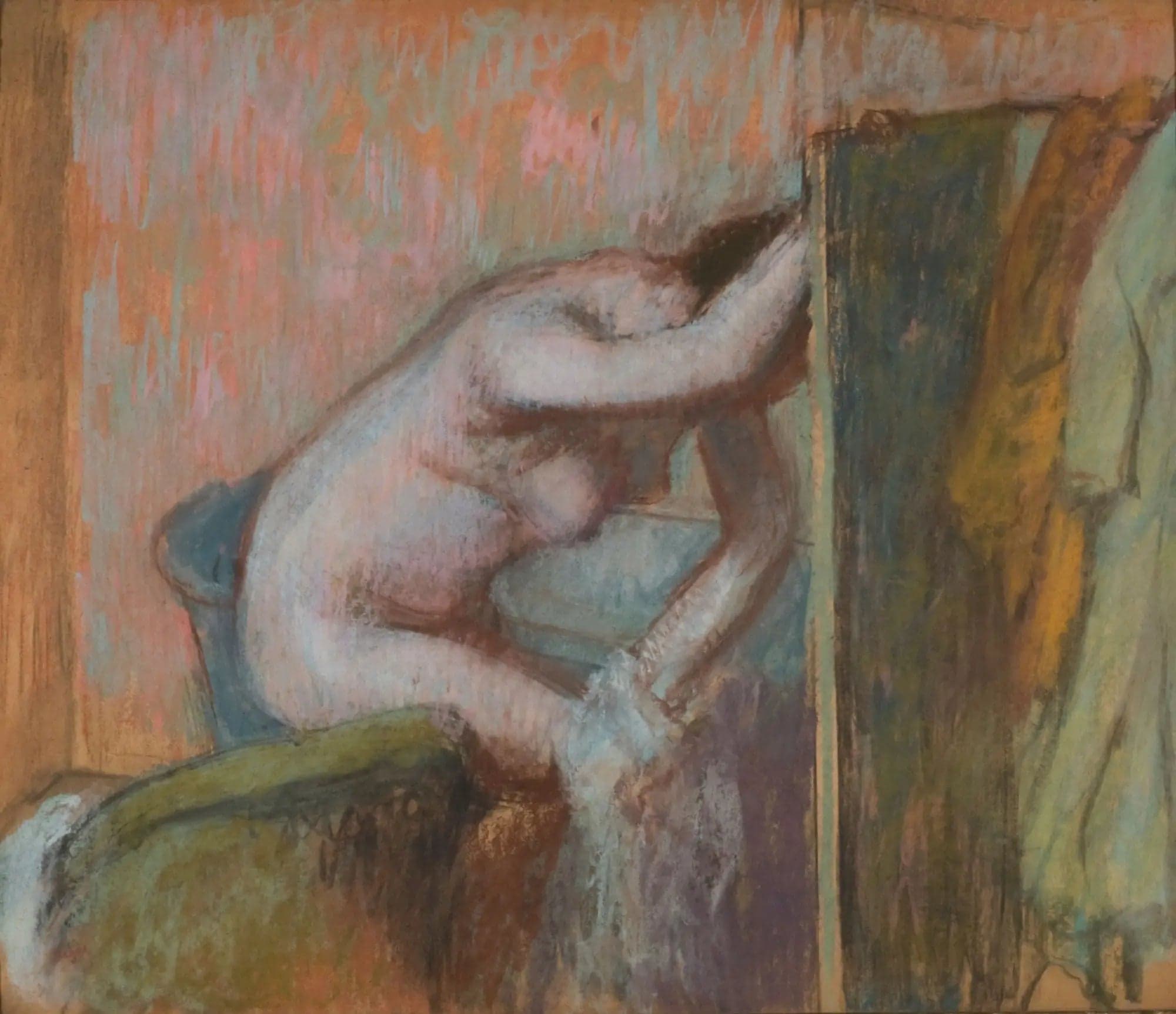
The Bath after the Bath
- Original dimensions
- 78.5 x 66.5 cm
- Museum
- National Museum of Fine Arts Buenos Aires
- Year
- 1888
Scene depicted
The scene depicted in this masterpiece explores the intimate ritual of a woman's bath. Revealing the subtleties of daily life, Degas photographs this moment with delicacy. In a warm environment, the female figure prepares, knowing that each gesture is imbued with natural charm. The canvas thus reveals a raw beauty, a meticulous work of the artist in his quest for authenticity.
Historical context
Created in 1888, this painting is located in the heart of Paris, an iconic city of artistic and cultural changes at the end of the 19th century. Edgar Degas , one of the masters of the Impressionist movement, sublimates in this painting a feminine intimacy marked by soft light. Currently, the original of this canvas resides at the National Museum of Fine Arts in Buenos Aires, where it continues to amaze visitors.
Place in the artist's career
The Bath after the Bath marks a turning point in Edgar Degas 's career, confirming his status as a great master. This painting represents a fusion of technique and sensitivity, in parallel with works such as “Absinthe” and “The Dancer.” Together, these paintings illustrate his artistic evolution, where he captures the essence of movement and human emotion.
Anecdote
“Every brushstroke is a whisper of life, an ode to fleeting beauty.” On one of those Parisian summer mornings, Degas was inspired by the light filtering through the blinds, creating a moment of serenity. This quote resonates through the evocative power of The Bath after the Bath , where each reflection seems to capture the evanescence of everyday life.