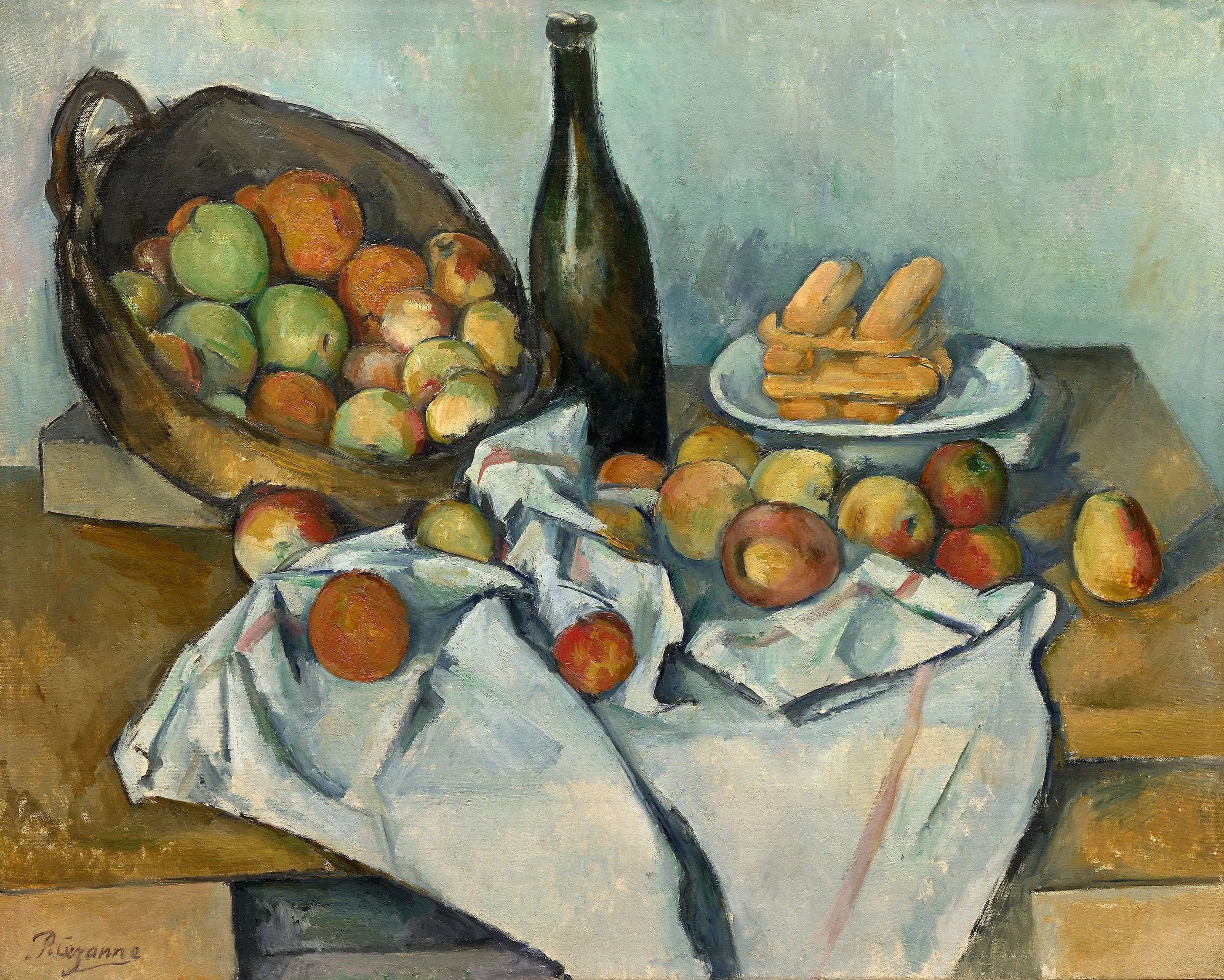
The Basket of Apples
- Original dimensions
- 80 x 65 cm
- Museum
- Art Institute of Chicago
- Year
- 1893
Scene depicted
This vibrant canvas is an intimate representation of a basket filled with apples, elegantly placed on a table, finely imitating the simplicity and beauty of still life. The harmonious composition immerses us in a world where each fruit seems to almost pulse, a true ode to the quest for realism and the brightness of colors. The lightness of the apples contrasts with the weight of the object that supports them, creating a refined tension, a true hallmark of Cézanne's artistic excellence.
Historical context
Created in 1893, The Basket of Apples is a magnificent illustration of expressionism post-impressionist that emerged in Aix-en-Provence, the hometown of Paul Cézanne , in France. This iconic work resonates with the echo of its time, capturing an essence of modernity while paying homage to the beauty of natural forms. Currently, this masterpiece rests in the Art Institute of Chicago , a prestigious place dedicated to artistic treasures, within a collection that celebrates the excellence of painting.
Place in the artist's career
The Basket of Apples represents a key stage in Cézanne's career, a moment when the artist's genius begins to be fully recognized, at a time when he gradually abandons academic conventions . In parallel, works such as "The Large Bathers" and "Mont Sainte-Victoire" highlight the artist's stylistic evolution, testifying to a shift towards a more pronounced abstraction and an increasingly personal perspective.
Anecdote
“Nature provides us with the means, but it is we who must plant our roots there,” Cézanne often said while contemplating the orchards of his youth. This quote evokes the artist's passionate quest to capture reality through the magic of color, and The Basket of Apples perfectly embodies this quest. Imagine Cézanne, one spring morning, surrounded by the sweet scent of ripe fruits, seeking to immortalize this fleeting moment on his canvas.