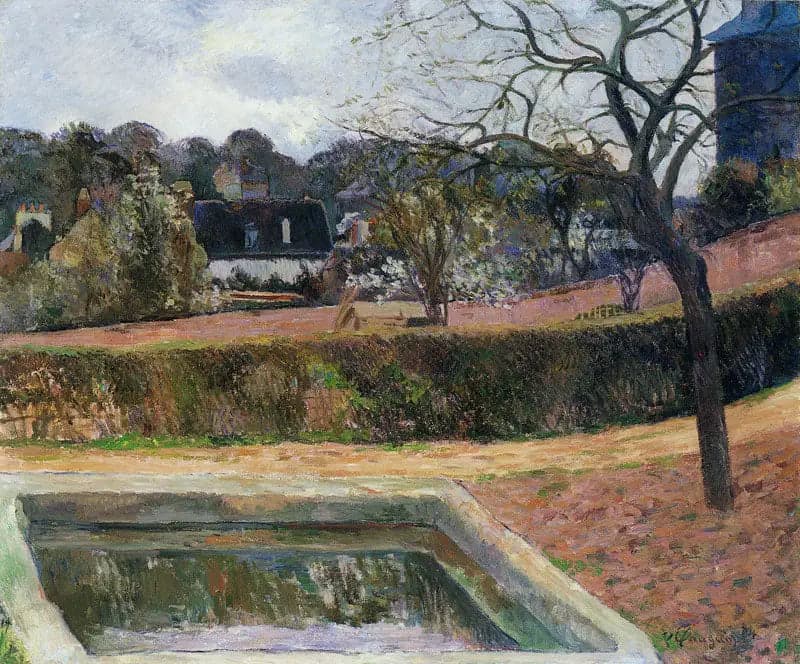
The Basin, or The Square Basin
- Original dimensions
- 65 x 54 cm
- Museum
- Not specified
- Year
- 1884
Scene depicted
The Basin, or The Square Basin, is a composition that invites the viewer to contemplate the calm that nature can offer. This canvas , where geometric lines and the serenity of the waters are highlighted, illustrates a moment of tranquility and reflection. The leaves surrounding the basin, the gentle movement of the water, all evoke a firm atmosphere of serenity, which reflects Gauguin's enthusiasm for bucolic landscapes.
Historical context
Created in 1884, this painting is set in the historical context of Pont-Aven, a Breton town that becomes an essential crossroads of the post-impressionist movement. It bears witness to a time of stylistic renewal where Gauguin, while exploring the play of light and colors, asserts himself as a major figure in art. Today, this canvas remains just as enigmatic and charming, although it is difficult to identify its current state.
Place in the artist's career
The Basin, or The Square Basin is situated at a turning point in Gauguin's career, reflecting a marked stylistic evolution. After works like The Yellow Christ and before his Polynesian period, this canvas reveals a maturity in the use of colors and forms. By comparing them with other works from the same period, we can observe a shift towards a more advanced abstraction in his upcoming creations.
Anecdote
“Nature is an eternal painting,” say the words one might attribute to Paul Gauguin . Imagine him, wandering in the golden light of a spring morning in Brittany, his palette in hand, perceiving the harmony at that precise moment, the softness of the reflections on the basin that inspires him to create this masterpiece . The painting is the echo of this vision, capturing the very essence of this enchanting place.