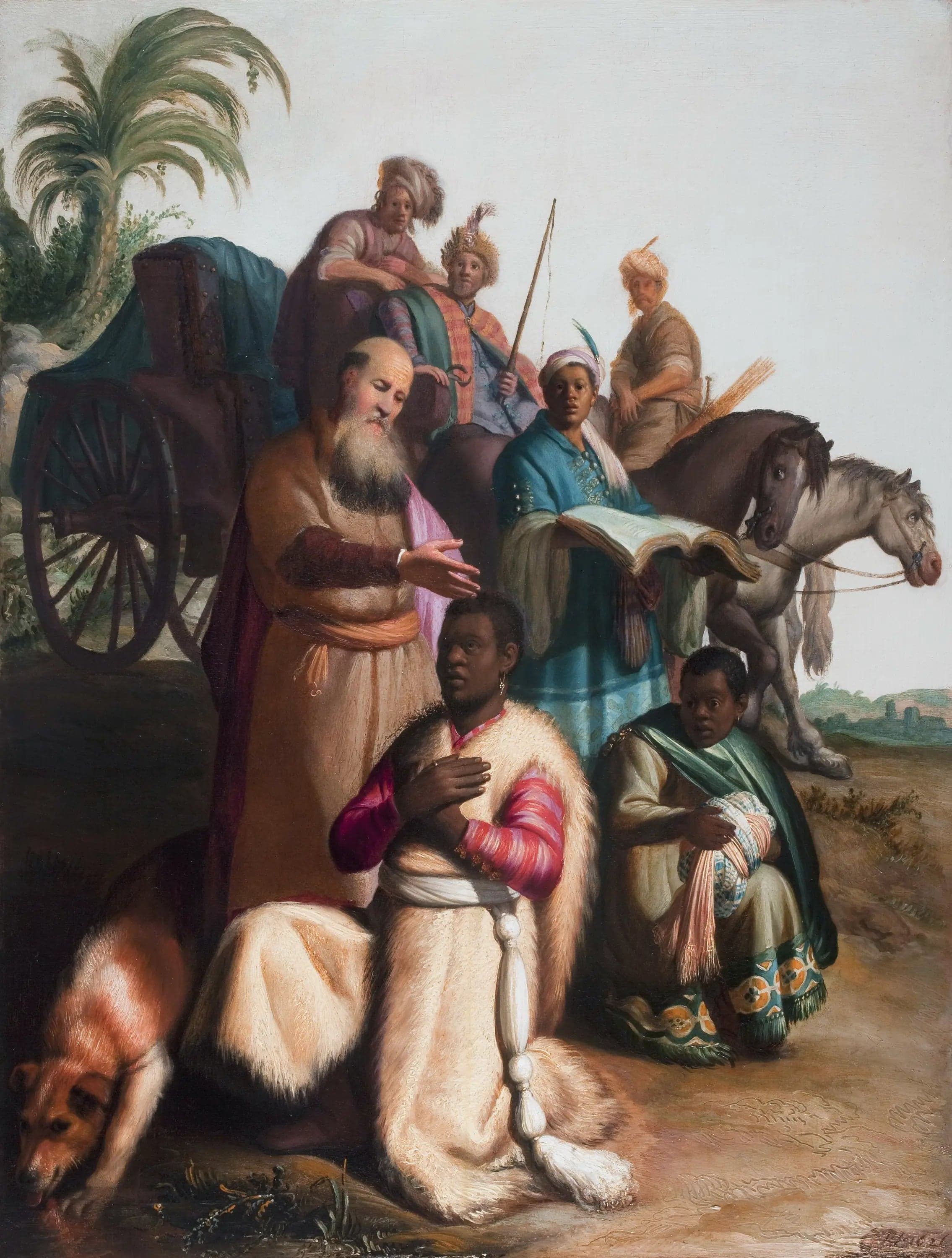
The Baptism of the Eunuch
- Original dimensions
- 47.5 x 64 cm
- Movement
- Dutch Golden Age
- Museum
- Museum of the Convent of Saint Catherine
- Year
- 1626
Scene depicted
In his pictorial work , Rembrandt immerses us in a significant spiritual scene. Pushing the boundaries of light and darkness, he captures the solemn moment of the baptism of an eunuch, a character symbolizing the universality of the Christian faith, transcending social and ethnic barriers. Its emotional power resonates with the soul of the viewer.
Historical context
This painting is emblematic and was created in 1626, a pivotal period of the Dutch Golden Age of painting, in Amsterdam. The work captures a moment of great gravity and emotion, enhanced by the brilliant light of biblical scenes. Today, it is preserved in the prestigious Museum of the Convent of Saint Catherine, a testament to the genius of Rembrandt and his time.
Place in the artist's career
This painting , although predating other masterpieces such as The Night Watch and The Anatomy Lesson of Dr. Tulp, marks a turning point in Rembrandt 's career. It stands at the crossroads of his meteoric rise and his mastery of chiaroscuro, reflecting his religious concerns while paving the way for his bolder later explorations.
Anecdote
“My brush is my heart, I paint each shadow like a harmonious note of music,” Rembrandt is said to have remarked while contemplating the inspiration that had overtaken him in his studio. Imagine him, one spring morning, lost in thought, when he crosses a gaze, a man rich in stories and secrets. This fleeting moment will nourish the evocative power of The Baptism of the Eunuch .
Major exhibitions
Rembrandt , 'de doop van de kamerling'