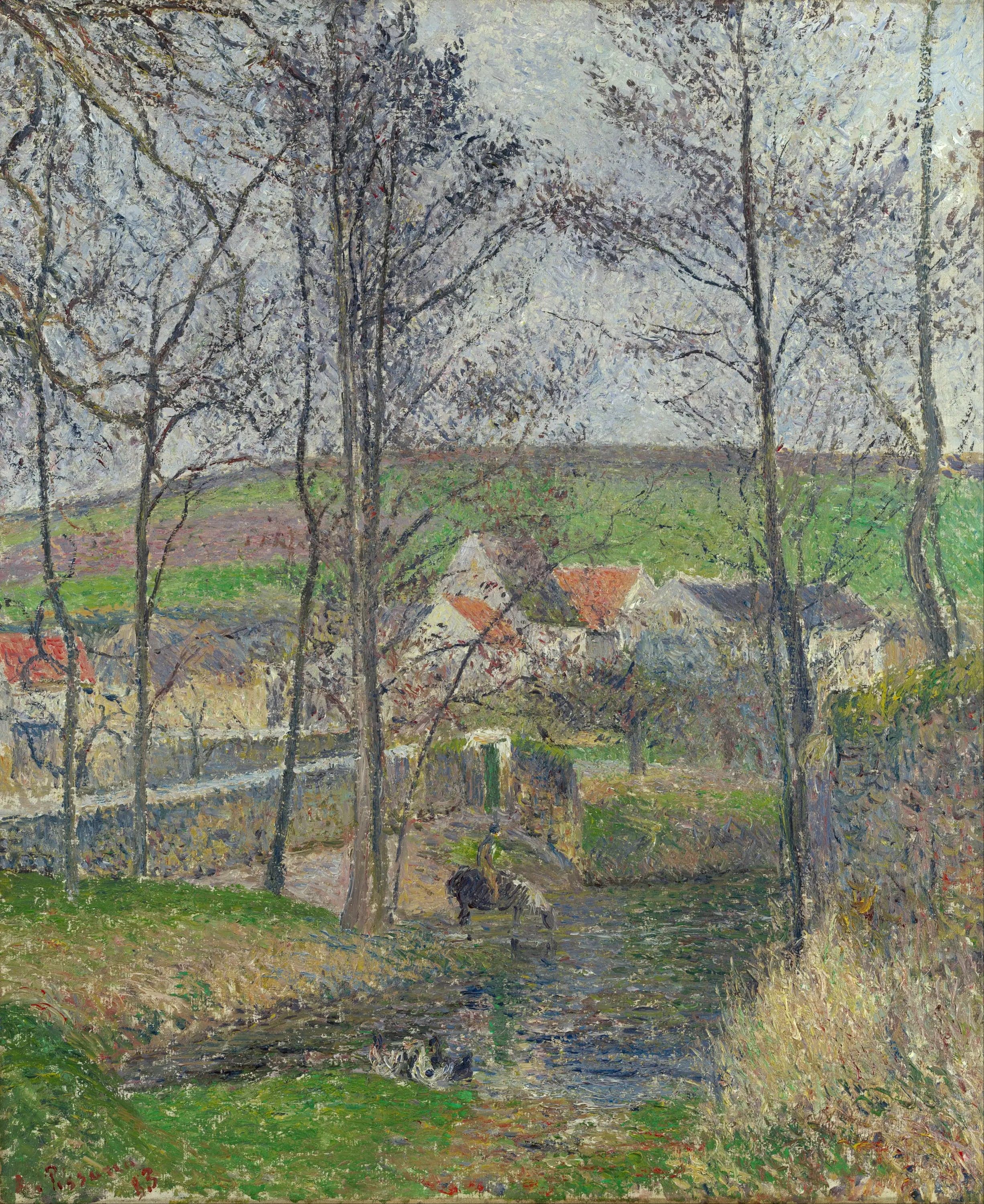
The Banks of the Viosne at Osny in Gray Weather, Winter
- Original dimensions
- 54.5 x 65.3 cm
- Museum
- National Museum of Victoria
- Year
- 1883
Scene depicted
In this painting, Camille Pissarro invites the viewer to contemplate a peaceful and introspective scene. The banks of the Viosne, draped under a gray sky, illustrate the melancholy and beauty of winter landscapes. The trees, bare and majestic, reflect on the slightly rippled surface of the river, while the muffled atmosphere evokes a serene tranquility, merging nature with human emotion.
Historical context
This painting , created in the heart of winter 1883, plunges its roots into the charming landscape of Osny, a small town in the Île-de-France region. Inscribed in the Impressionist movement, this canvas illustrates the artistic aspirations of its time, where capturing the nuances of light and harmony with nature took precedence over frozen realism . Today, the painting is preserved at the National Museum of Victoria , a setting that preserves its original brilliance and testifies to the fleeting beauty of the seasons.
Place in the artist's career
This painting is situated at a turning point in Pissarro's career. In 1883, he explores the relationships between light and shadow, maturing in his Impressionist style. Like other masterpieces such as Boulevard Montmartre, spring and Rue de l'Église in Éragny , this painting testifies to his artistic evolution and quest for perfection, illustrating how each canvas nourishes the next.
Anecdote
“Nature inspires me as much as it moves me,” could have said Camille Pissarro when evoking the genesis of his masterpiece . While contemplating the banks of the Viosne, a silence punctuated by the distant song of birds emerged, all while experiencing the magic of winter, that moment when each snowflake tells a story. This painting represents not only a scene but also a moment stolen from time, a deep connection between the artist and his environment.