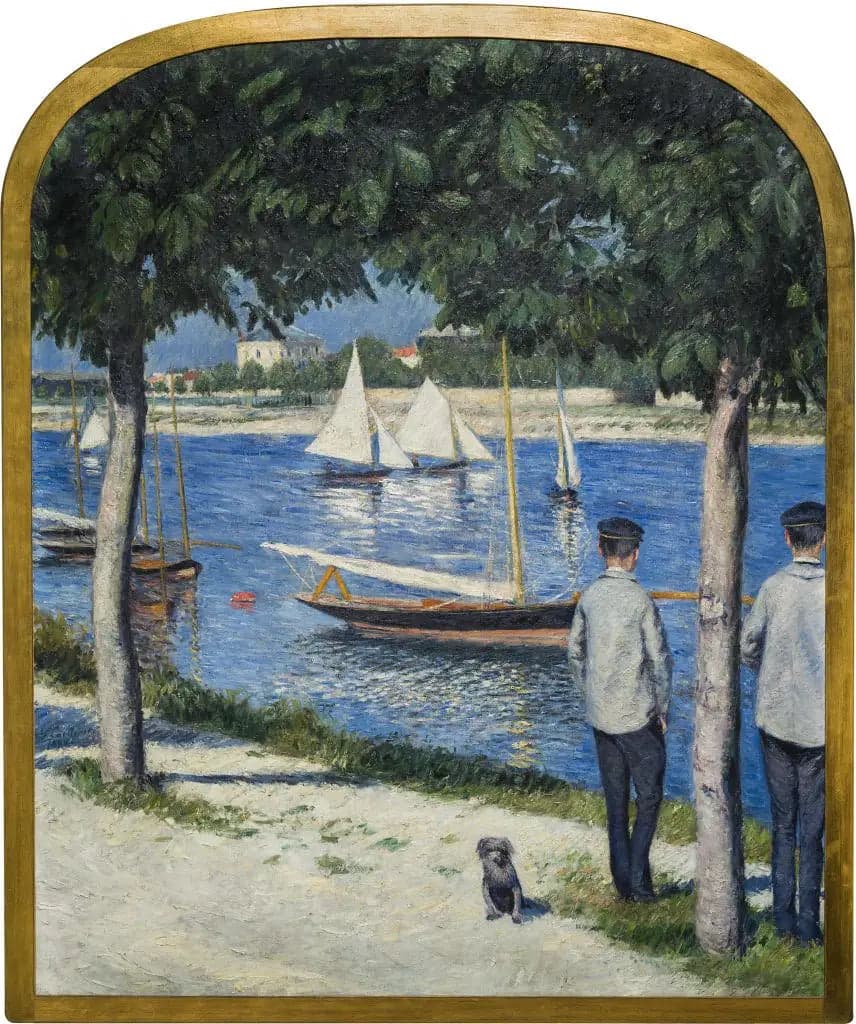
The Bank of Petit Gennevilliers and the Seine
- Original dimensions
- 127 x 153 cm
- Museum
- Not specified
- Year
- 1890
Scene depicted
This painting illustrates with incredible precision the bank of the Seine, where nature and urbanity meet. Strollers, boats gliding gently on the water, and the architecture in the background create a living tableau that speaks to all who contemplate it. The nuances of light and water reflections add a fascinating depth, transforming this canvas into a warm and inviting pictorial work.
Historical context
Created in 1890, this painting is an iconic work of the Impressionist movement that transports us to the banks of the Seine, in Petit Gennevilliers, a place where light sparkles through the water. Gustave Caillebotte , a pioneer of this artistic movement, captures in this canvas the very essence of urban life at the end of the 19th century. Currently, this painting is preserved in private collections, testifying to a fervent journey through time.
Place in the artist's career
This painting stands as a major work in Caillebotte's career. A significant fact, it represents a period of artistic maturity, where his style asserts itself. Alongside his other iconic works such as “The Floor Scrapers” and “The Bridge of Europe,” the Bank of Petit Gennevilliers and the Seine testifies to a controlled and touching evolution, capturing moments of life with rare sensitivity.
Anecdote
“Art is a means of capturing fleeting moments, emotions that only the eye can feel.” This quote could reflect the spirit that permeated the creation of his painting . Imagine a sunny morning in Petit Gennevilliers, the air fragrant with the scent of fresh water awakening to the distant sounds of a bustling city. This unique atmosphere resonates through every brushstroke of Caillebotte.
Major exhibitions
Private collections: A journey from Impressionists to Fauves