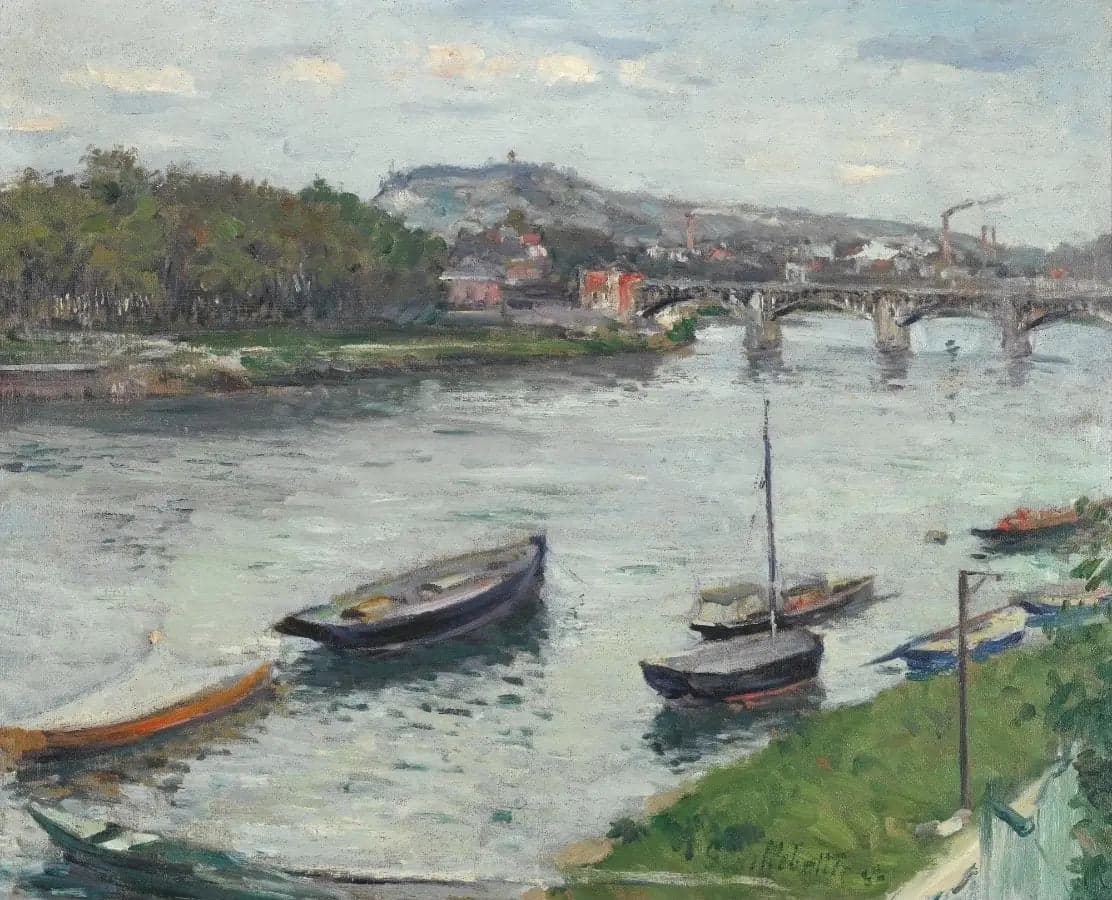
The Bank and the Bridge of Argenteuil
- Original dimensions
- 73 x 60 cm
- Museum
- Not specified
- Year
- 1882
Scene depicted
In this canvas , the scene depicts walkers on the banks of the river, surrounded by a vibrant and luminous landscape. The bridge of Argenteuil, famous at the time, connects the banks, while the water comes to life under the reflections of the last rays of the sun. It is an invitation to feel the softness of a peaceful moment in nature, capturing the ephemeral beauty of the moments that compose our existence.
Historical context
This painting , created in 1882 in Argenteuil, an iconic city of the Paris region, is part of the Impressionist movement. At that time, Caillebotte explores the relationships between man and his environment, while capturing the light and movement of the nature that surrounds him. The canvas is currently part of unspecified collections, but remains an essential work for understanding the pictorial development of the late 19th century.
Place in the artist's career
This painting represents a turning point in his artistic career. Caillebotte, already recognized for his technical mastery, continues to refine his style with works such as “The Bridge of Europe” and “The Reeds,” which share a contemporary approach to landscape while integrating elements of daily life. This masterpiece testifies to his evolution towards an emotional fusion with his subject.
Anecdote
“The light of this scene is a melody that only the eye can hear.” Thus expressed Caillebotte, recalling an April morning when he found inspiration in the serenity of the banks of the Seine. This canvas is a reflection of that moment stolen from nature, where every nuance of paint transcribes the emotion of a meeting between art and landscape.