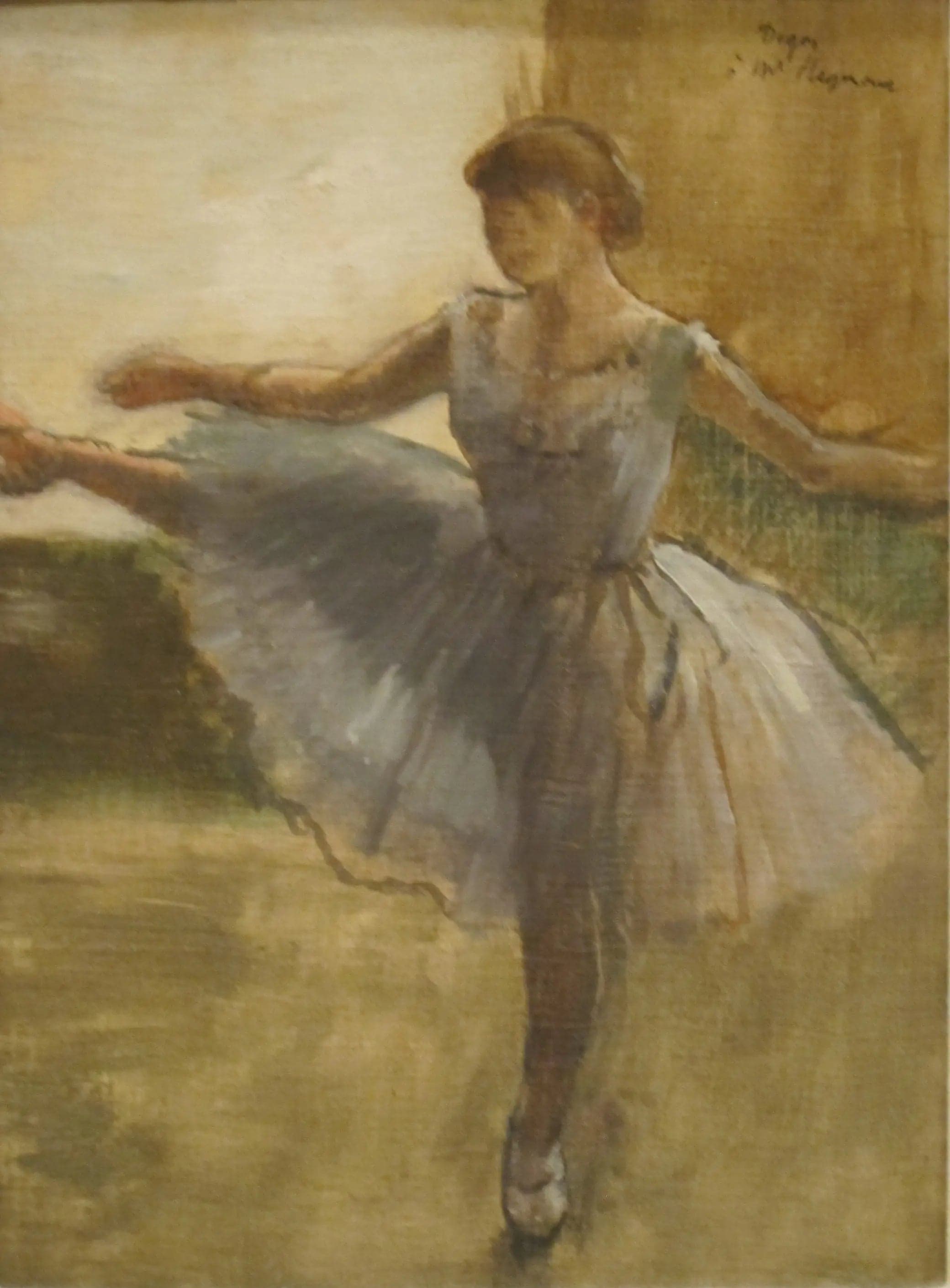
The Ballerina
- Original dimensions
- 23.8 x 32 cm
- Museum
- San Diego Museum of Art
- Year
- 1876
Scene depicted
In this painting , Degas captures a ballerina in full rehearsal, her body stretching gracefully, while the fleeting reflection of movement seems suspended in time. The painting reveals not only the professionalism of this dancer but also the fragility and beauty of the creative process. The scene is immersed in a soft light that accentuates the fluid lines of her silhouette, creating an atmosphere of intimacy and artistic tension all at once.
Historical context
Created in 1876, in the vibrant city of Paris, The Ballerina is part of Impressionism , an artistic movement that explores the capture of light and movement. At this time, the world of classical dance becomes a revelation for artists, inspiring compositions that capture the fleeting essence of the moment. This painting is emblematic of Degas's genius and is currently housed at the San Diego Museum of Art , where it continues to amaze visitors with its refined technique and vibrant expressiveness.
Place in the artist's career
The Ballerina represents a turning point in the career of Edgar Degas . This canvas is part of a period where he refines his style, exploring themes of dance and movement. Compared to other works such as The Dance Class (1874) and The Dancers (1898), one can perceive the evolution of his technique and his unique ability to convey complex emotions through movement. This masterpiece testifies to Degas's progressive mastery in rendering textures and lights.
Anecdote
Degas once stated: "Dance is the most beautiful expression of art." This reflection, captured on a stormy morning, led him to immortalize the grace of a ballerina in full practice. In this painting , the brilliance of light penetrating the scene and the delicate movement of the dancer reveal the beauty of movement in a moment of eternity. The Ballerina is more than a pictorial work; it is an invitation to feel the beauty of the moment.