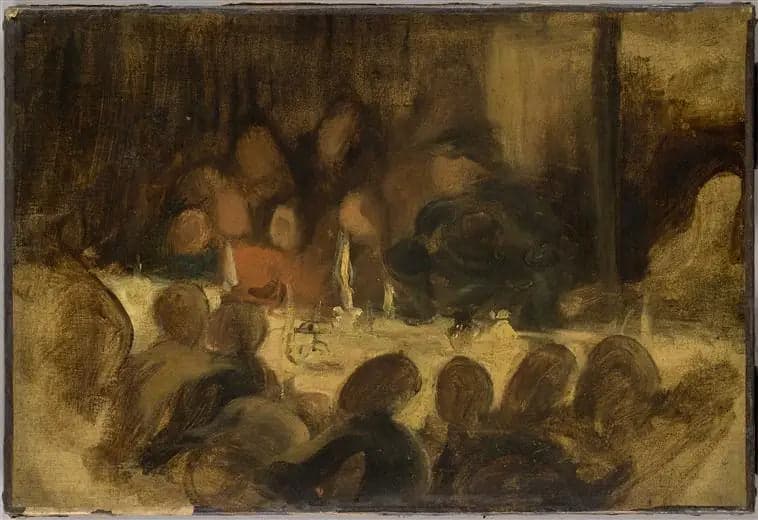
The Assassination of the Bishop of Liège
- Original dimensions
- 116 x 91 cm
- Museum
- room 942
- Year
- 1828
Scene depicted
This captivating painting captures the tragic moment of the bishop's assassination, a significant event that shook the city. Grasping its symbol of pain and revolt, Delacroix stages a composition with striking realism, where each character expresses intense emotion. The palpable tension, frozen in time, transports the viewer to the heart of the action, revealing the brutality and beauty of a human drama.
Historical context
Created in 1828, this iconic work is deeply rooted in the history of the city of Liège, in the heart of Belgium. Its design is part of a romantic movement, reflecting a turbulent time when art emancipates itself. Currently on display at the museum, this canvas attracts art enthusiasts with its imposing dimensions of 116 x 91 cm, highlighting Delacroix's unparalleled talent.
Place in the artist's career
The Assassination of the Bishop of Liège sits at a crossroads in Delacroix's career. It is a mature work that reveals his iconic style. Alongside it, other paintings such as Liberty Leading the People and The Massacre at Chios showcase the evolution of his art, from bold combinations of light and shadow to the exploration of the human psyche.
Anecdote
Delacroix once stated: “Painting is the art of expressing everything through nothing.” These words resonate deeply in the masterpiece that is The Assassination of the Bishop of Liège . Imagine him, one spring morning, wandering the streets of Paris, his sensitivity awakened by a distant melody, or a persistent cry... Each brushstroke is an echo of that original emotion, vibrating through the canvas.
Major exhibitions
Salon of 1831