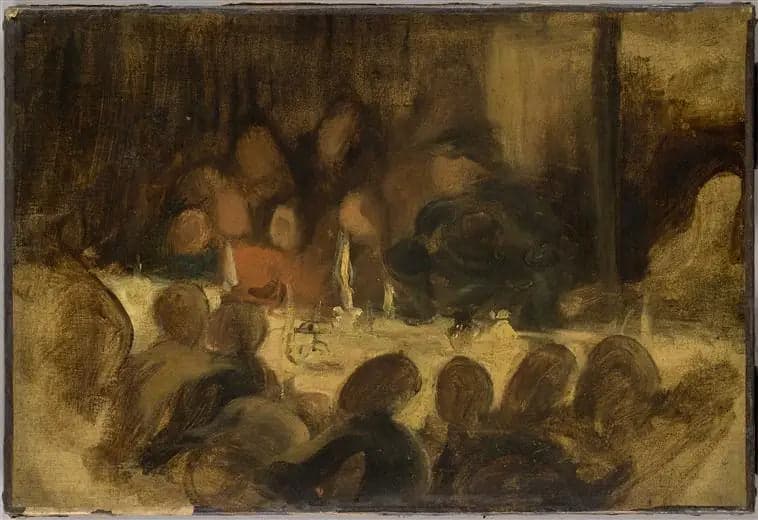
The Assassination of the Bishop of Liège
- Original dimensions
- 46 x 31 cm
- Museum
- national museum Eugène-Delacroix
- Year
- 1827
Scene depicted
This captivating painting illustrates the tragic assassination of the Bishop of Liège, a tale of betrayal and honor. The artist, with unmatched narrative power, captures the movement and tension of this crucial moment, plunging the viewer into an atmosphere of shock and dismay. The characters frozen in this melodramatic composition seem to tear themselves from the canvas to narrate the human tragedy, each face crying out a story forgotten through the ages.
Historical context
Created in 1827, this painting is set against the tumultuous backdrop of the early 19th century. Paris, where it was born, is then the vibrant heart of the romantic movement in full swing. Immersed in historical tragedies, the work is situated in a context steeped in religious and political conflicts, paying tribute to past events whose echoes still resonate. Currently, this canvas is preserved in the national museum Eugène-Delacroix, where visitors can admire its dimensions of 46 x 31 cm, testifying to the excellence of the artist's brush.
Place in the artist's career
The Assassination of the Bishop of Liège stands as a pivot in Delacroix's career, combining his emergence in the romantic movement with his ascent to excellence. Compared to Liberty Leading the People and The Massacre of Chios , this canvas illustrates a period of creative maturity, where the artist guides his audience through intense emotions, revealing a mastery of light and drama that transcends time.
Anecdote
“Life is a canvas, and inspiration is a gentle wind that wrinkles the sails,” said Delacroix, reminding his contemporaries that every masterpiece is born from a spark of life. Imagine him one morning, strolling down a sunlit alley, observing faces imbued with history, the breath of inspiration coursing through his being like a ray of light caressing the canvas at that very moment. This vibrant essence is found in The Assassination of the Bishop of Liège, where each brushstroke evokes the dizzying drama of the depicted scene.