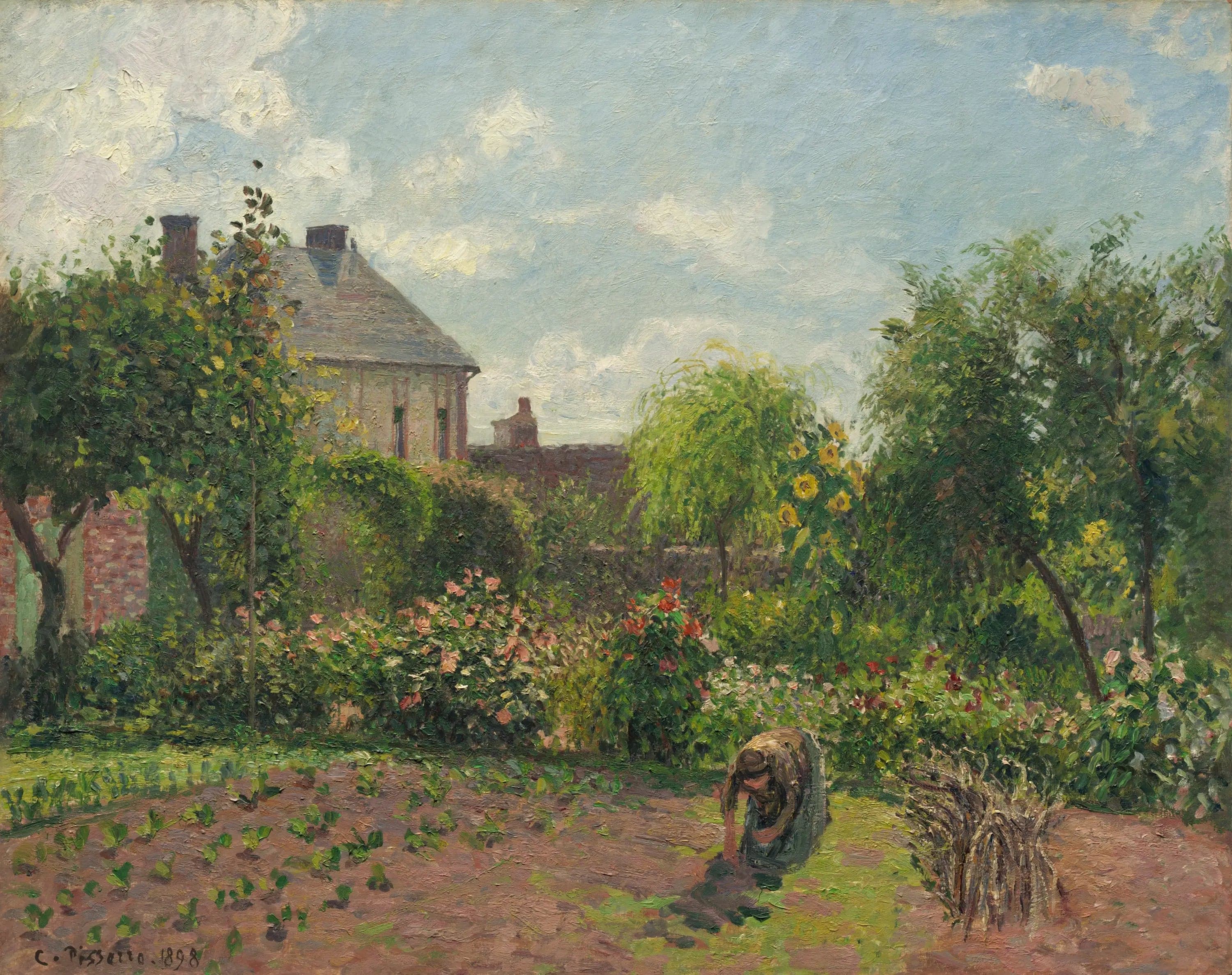
The Artist's Garden at Eragny
- Original dimensions
- 92.1 x 73.4 cm
- Museum
- National Gallery of Art
- Year
- 1898
Scene depicted
This painting is a delicate immersion into Pissarro's garden. It reveals a lush landscape, where nature dances under the gentle rays of the sun. The composition is populated with abundant vegetation, vibrant flowers, and majestic trees, reflecting the artist's deep respect for the beauty of the world around him. It is a celebration of life with every brushstroke, a pictorial poem dedicated to nature.
Historical context
Created in 1898 in the charming village of Eragny, located in France, The Artist's Garden at Eragny is part of the Impressionist movement, which challenges the artistic conventions of the time. Camille Pissarro , one of the iconic masters of this movement, offers us a window into the natural world through his attentive and poetic gaze. Today, this painting resides at the National Gallery of Art , a place that celebrates the greatest masterpieces in history.
Place in the artist's career
The Artist's Garden at Eragny represents a period of maturity for Pissarro, who, after exploring different techniques and personalities of the Impressionist movement, captures here the very essence of his art. This painting stands alongside other iconic works such as The Hay Harvest and The Boulevard Montmartre, Spring , showcasing his evolution, both emotionally and technically, as he develops his unique style with light and color.
Anecdote
“Nature is an inexhaustible spectacle that deserves to be told by each of us,” Pissarro liked to say. One spring morning, in his garden in Eragny, he felt the vibrant inspiration of the living world around him. The painting that resulted, The Artist's Garden at Eragny , captures this vibrant frenzy of colors and light, an echo of his vision of the simple yet profound happiness of life.