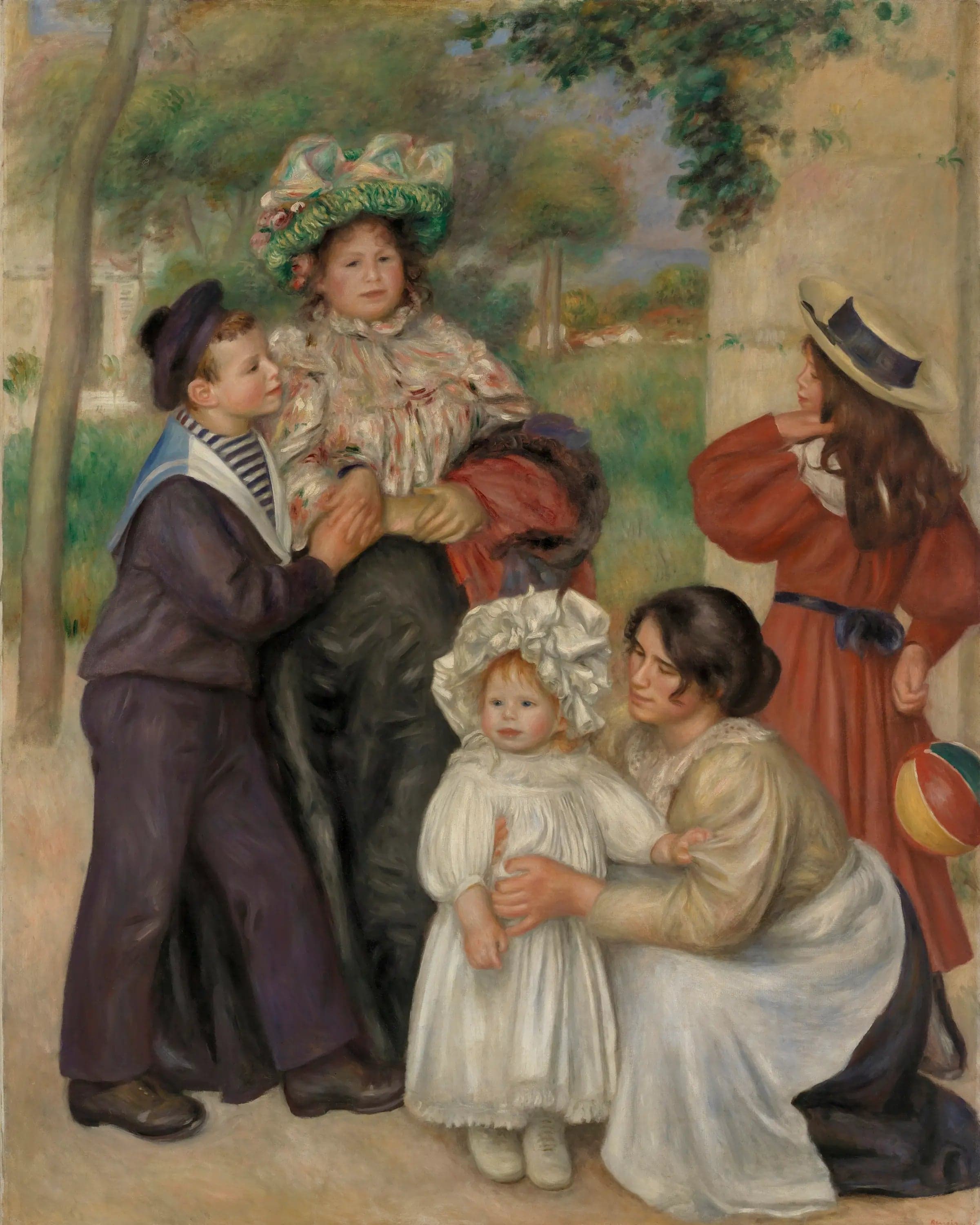
The Artist's Family - Pierre
- Original dimensions
- 137.2 x 173 cm
- Museum
- Barnes Foundation
- Year
- 1896
Scene depicted
This painting features Renoir's family in a bucolic setting where laughter intertwines with sunlight. The members, surrounded by lush flowers, engage in a warm intimacy that recalls the tenderness of family bonds. This humanistic influence radiates through every brushstroke, magnifying the beauty of the relationships woven between these loved ones, fully connected to their environment.
Historical context
Created in 1896, this iconic work by Pierre- Auguste Renoir is located in Philadelphia, where it is preserved at the Barnes Foundation . This canvas belongs to the Impressionist movement, which originated in France, and embodies the richness and vibrancy of this artistic period. It is a true testament to the era in which it was created, a time when pictorial art emancipated itself from academic norms to celebrate light and color. The painting, a vibrant composition, draws the eye and speaks to the soul of visitors.
Place in the artist's career
The Artist's Family holds a significant place in Renoir's artistic journey, marking a period of deep maturity. This painting follows other major works, such as "Luncheon of the Boating Party" and "Ball at the Moulin de la Galette," where the artist increasingly explores themes of joy and conviviality. Here, one perceives an evolution towards a more personal and intimate representation, capturing precious moments.
Anecdote
Renoir often said: "Life is a beauty, you just have to know how to observe it." This beating heart of the artist manifests in this masterpiece, inspired one spring morning, as he contemplated the joy of his own family in the blooming garden. The brightness of the day rang like a promise: to capture love and complicity, while creating a pictorial work that elevates the ordinary to the extraordinary under the delicate brush.