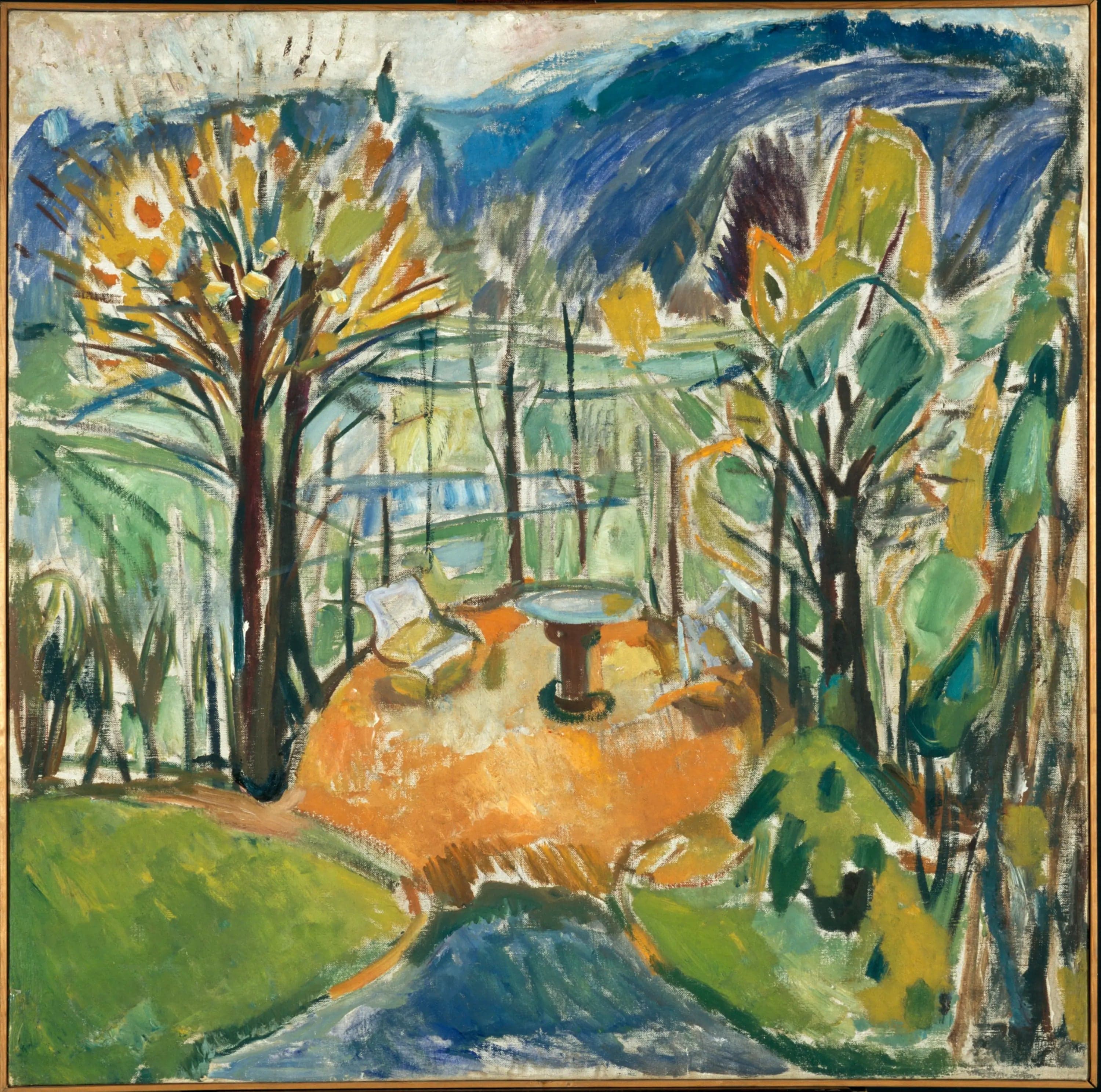
The Arbor at the End of Autumn
- Original dimensions
- 116.5 x 138.5 cm
- Museum
- Munch Museum
- Year
- 1926
Scene depicted
This painting evokes a suspended moment, where nature, in decline, reveals itself in all its emotional splendor. The warm colors intertwine with the shadows of everyday life, revealing a serene garden, enveloped in mystery and melancholic softness. Each brushstroke embodies the quest for balance between human existence and Nature, a pictorial work that transports the viewer into a world filled with countless reflections.
Historical context
Created in 1926 in Oslo, this canvas , emblematic of the expressionist movement, bears witness to the torments and emotions of a pivotal era. The painting is now housed in the Munch Museum, a precious setting that celebrates the legacy of this extraordinary artist. The work, rich at 116.5 x 138.5 cm, offers a dive into a universe imbued with melancholy and beauty.
Place in the artist's career
The Arbour at the End of Autumn represents a significant milestone in Munch's career, marking a period of artistic maturation. Alongside other iconic paintings such as “The Scream” and “The Madonna,” this work reveals a technical evolution, addressing similar themes of suffering and beauty, with an ever-increasing emotional depth.
Anecdote
“Art is the expression of life, and each canvas reveals a fragment of our soul.” This quote from Edvard Munch resonates with the creation of The Arbour at the End of Autumn , born on an autumn day, as the leaves fell with a nostalgic softness. In this moment, the artist captures a fleeting essence, the transient beauty that becomes immortal through his painting .
Major exhibitions
Munch og Ekely: 1916-1944