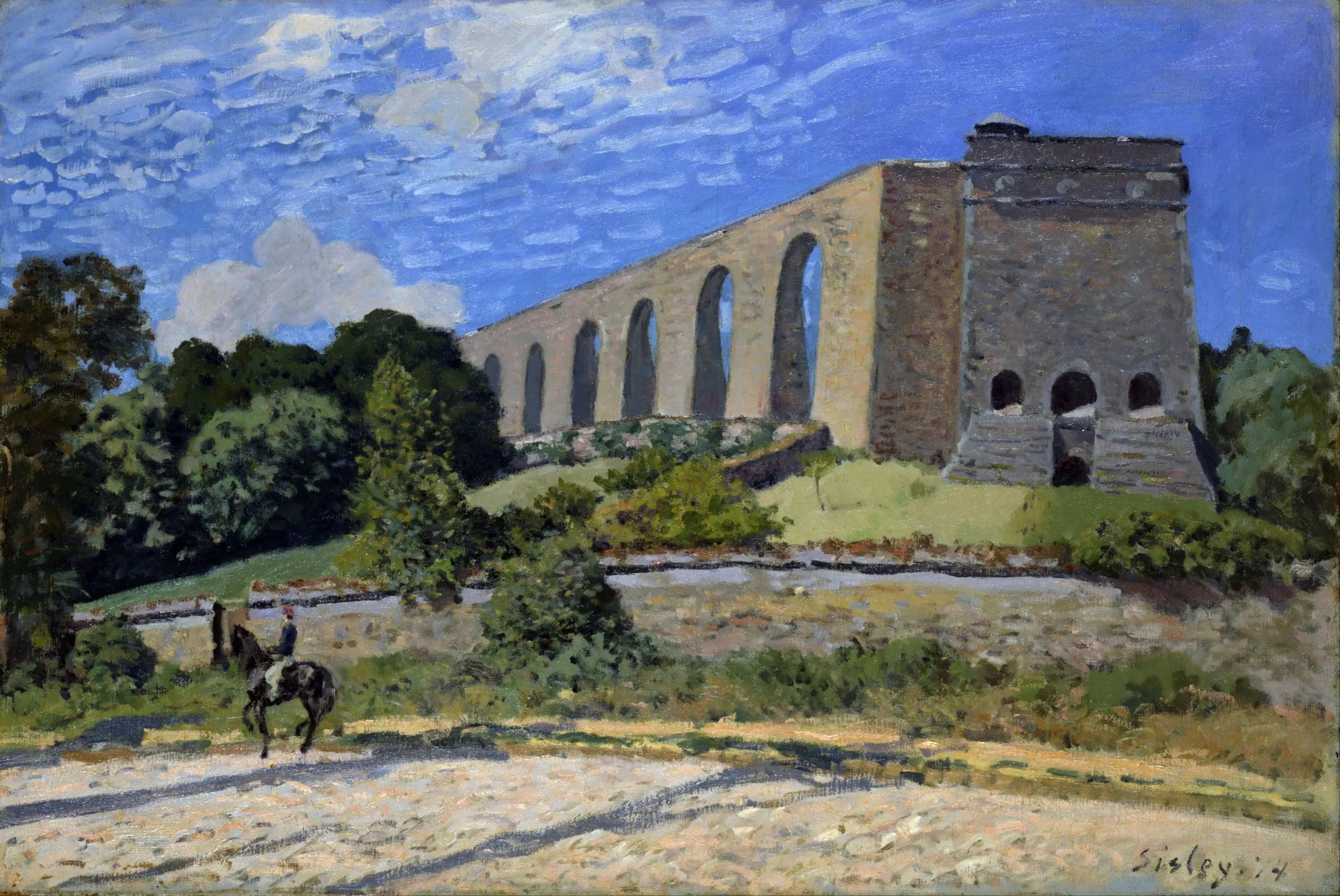
The Aqueduct of Marly
- Original dimensions
- 813 x 543 cm
- Museum
- Toledo Museum of Art
- Year
- 1874
Scene depicted
This iconic canvas captures a view of the aqueduct transformed by time, a majestic bridge that connects sky and earth. Through his pictorial work , Sisley immerses us in a soothing atmosphere, where the reflections of a soft twilight light blend with the tranquility of the surrounding waters.
Historical context
Created in 1874 in the town of Marly-le-Roi, this painting by Sisley belongs to the Impressionist movement, a time when light and nature intertwine at the whim of the brushes. While capturing the essence of a world in full transformation, this canvas is now located at the Toledo Museum of Art , a perfect setting for this work inspired by the aquatic beauty of the region.
Place in the artist's career
Considered one of his greatest successes, The Aqueduct of Marly marks an evolution in Sisley's career, oscillating between his promising beginnings and a stylistic peak. In parallel, his other canvases such as The Haystacks (1890) and The Canal of Loing (1885) offer a unique exploration of light and landscape, testifying to a talent in full maturation.
Anecdote
In a story shared with a friend, Sisley emotionally recalled the precise moment of its creation: "There is a special magic when the first rays of the sun caress the water, each wave dances like a reflection of our thoughts." This masterpiece was born one spring morning, when nature was awakening, illuminating the canvas with its gentle light.