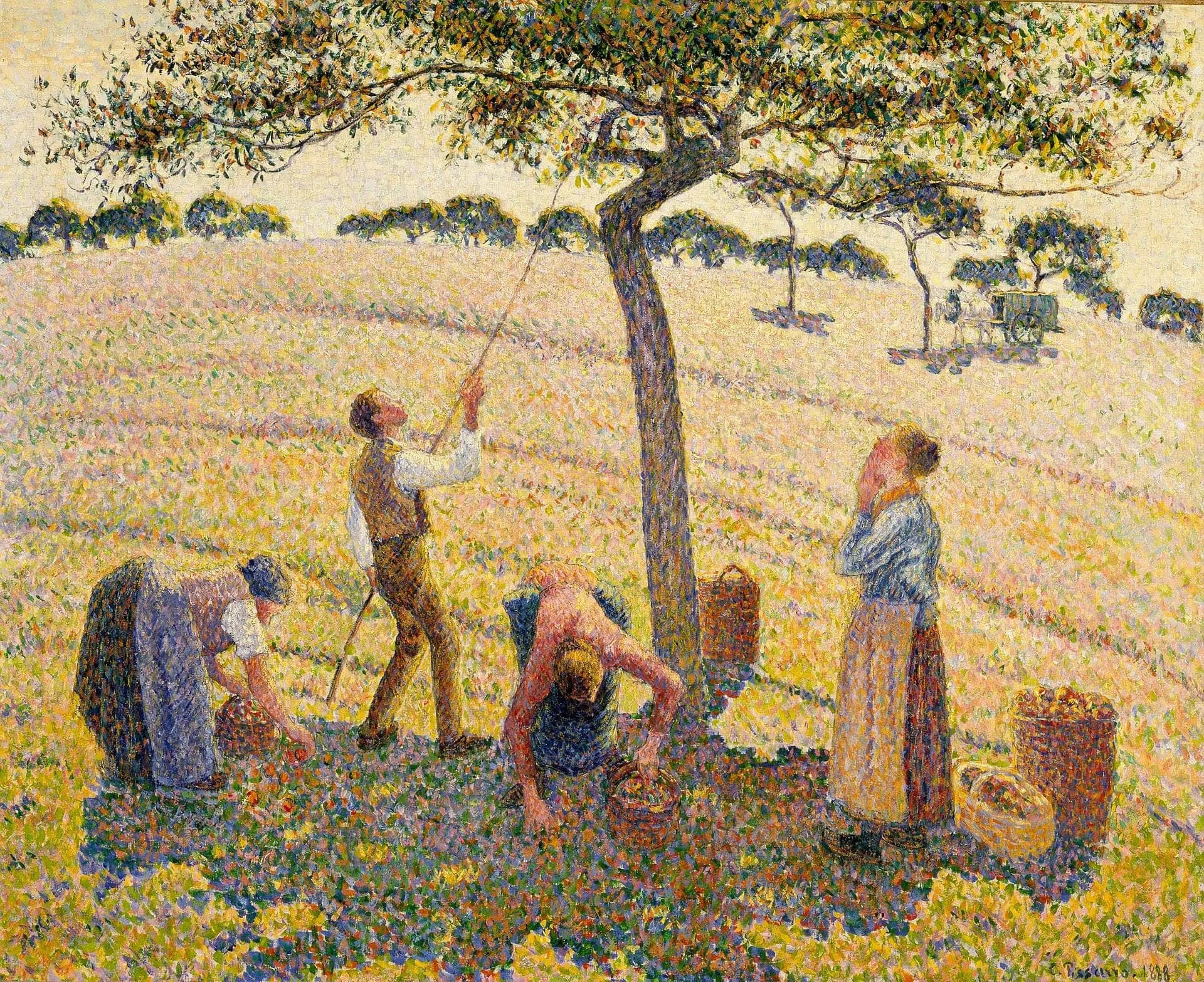
The Apple Harvest at Éragny
- Original dimensions
- 73 x 60 cm
- Movement
- neo- impressionism
- Museum
- Dallas Museum of Art
- Year
- 1888
Scene depicted
The painting “The Apple Harvest at Éragny” illustrates a group of men and women, engaged in the apple picking, while the golden sunlight weaves through the branches laden with fruit. The scene captures the harmony between man and nature, a theme dear to Pissarro, thus representing the cycle of life in full bloom during the beautiful autumn season.
Historical context
Created in 1888, this painting emblematic finds its roots in the charming village of Éragny-sur-Epte, France, at the heart of the neo- impressionist movement. Pissarro, in search of authenticity, draws inspiration from the surrounding countryside, capturing the essence of an era where nature and agricultural work are celebrated. Currently exhibited at the Dallas Museum of Art , this canvas of 73 x 60 cm reveals the evocative power of a moment suspended in time, where the rhythm of the seasons and the labor of men combine into a composition vibrant.
Place in the artist's career
This painting is situated at a decisive turning point in the career of Camille Pissarro , marking an affirmation of his neo- impressionist style at a time when he combines technique and emotion. Compared to other famous works, such as “Boulevard Montmartre, Spring” and “The Pea Harvest,” this canvas shows a notable evolution in his approach to colors and light, reflecting an artistic maturity in full expansion.
Anecdote
“Every color I touch reminds me of the life that pulses around me,” said Pissarro, inspired by the blooming orchards one spring morning. It is under this blue sky that he captured the moment when the apple trees, laden with fruit, offer an image of abundance and joy, immortalized in his painting , awakening our collective memory to the simple beauty of everyday life.