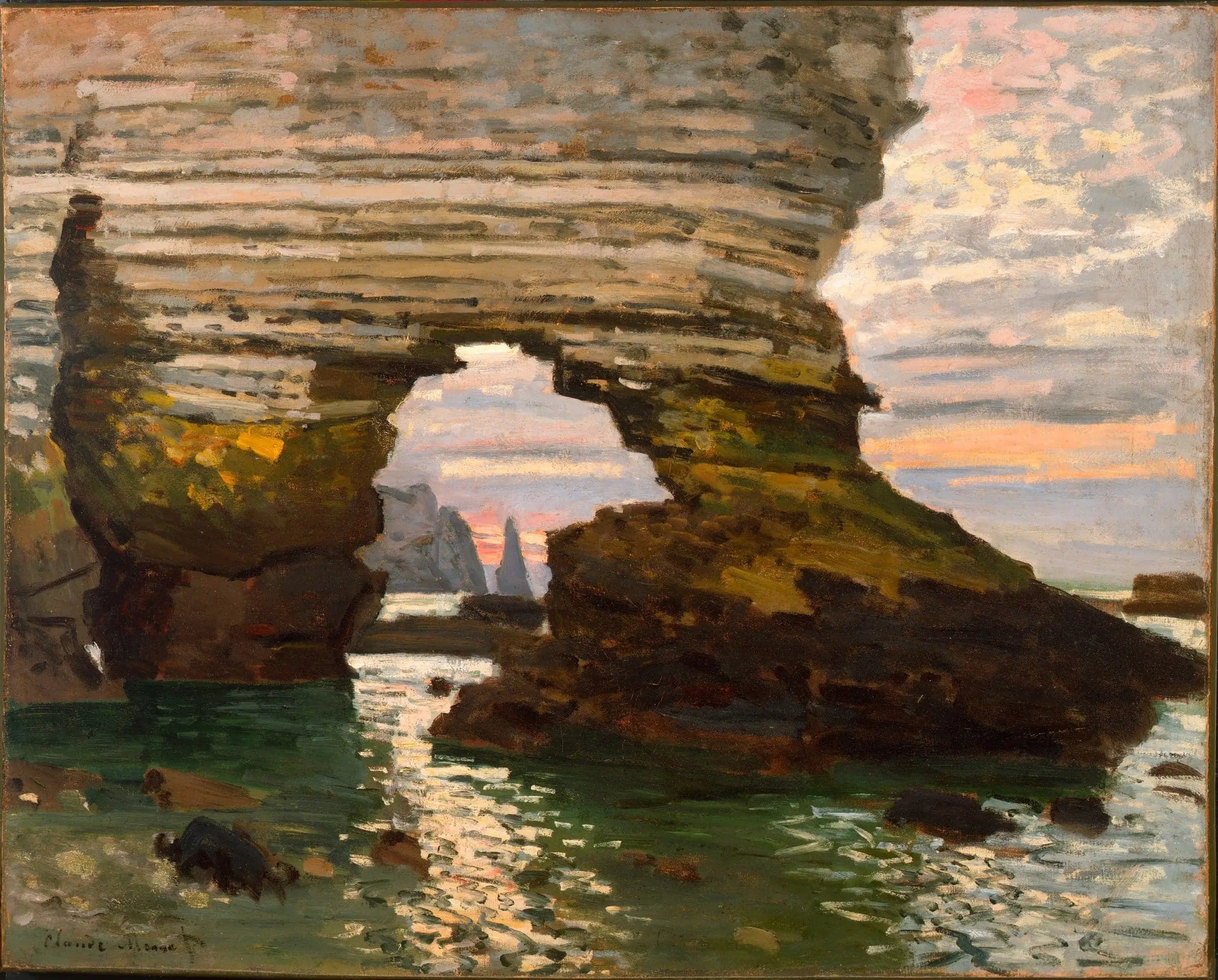
The Amont Gate, Étretat
- Original dimensions
- 98.4 x 79.1 cm
- Museum
- Harvard Art Museums
- Year
- 1868
Scene depicted
This painting presents a striking panorama of the famous cliffs of Étretat , highlighting the majesty of nature against the power of the ocean. The composition invites the viewer to contemplate the raw and ephemeral beauty of the Norman coastline, where each brushstroke seems to whisper the waves and the salty air. The natural architecture of the rock formations stands majestically, enveloped in soft and moving light, typical of Monet's art.
Historical context
Year: 1868 |BRK| Museum: Harvard Art Museums |BRK| Dimensions: 98.4 x 79.1 cm
Place in the artist's career
The Porte d'Amont, Étretat occupies a central position in Monet's career as one of his most significant works from the Impressionist period. This painting represents an early vision of his emerging style, where the technique of free brushwork begins to assert itself. In comparison with Impression, Sunrise and The Water Lilies , this painting reveals his progression towards a more emotional and personal representation of the natural world.
Anecdote
“I would not take a brush if I could not reproduce the emotion of a moment,” said Monet. That morning, as the sun rose over the cliffs of Étretat , he felt an artistic revelation. The light danced on the waves, creating a symphony of vibrant colors. It is this profound moment of inspiration that brought The Porte d'Amont, Étretat to life, forever capturing the fleeting beauty of the landscape.