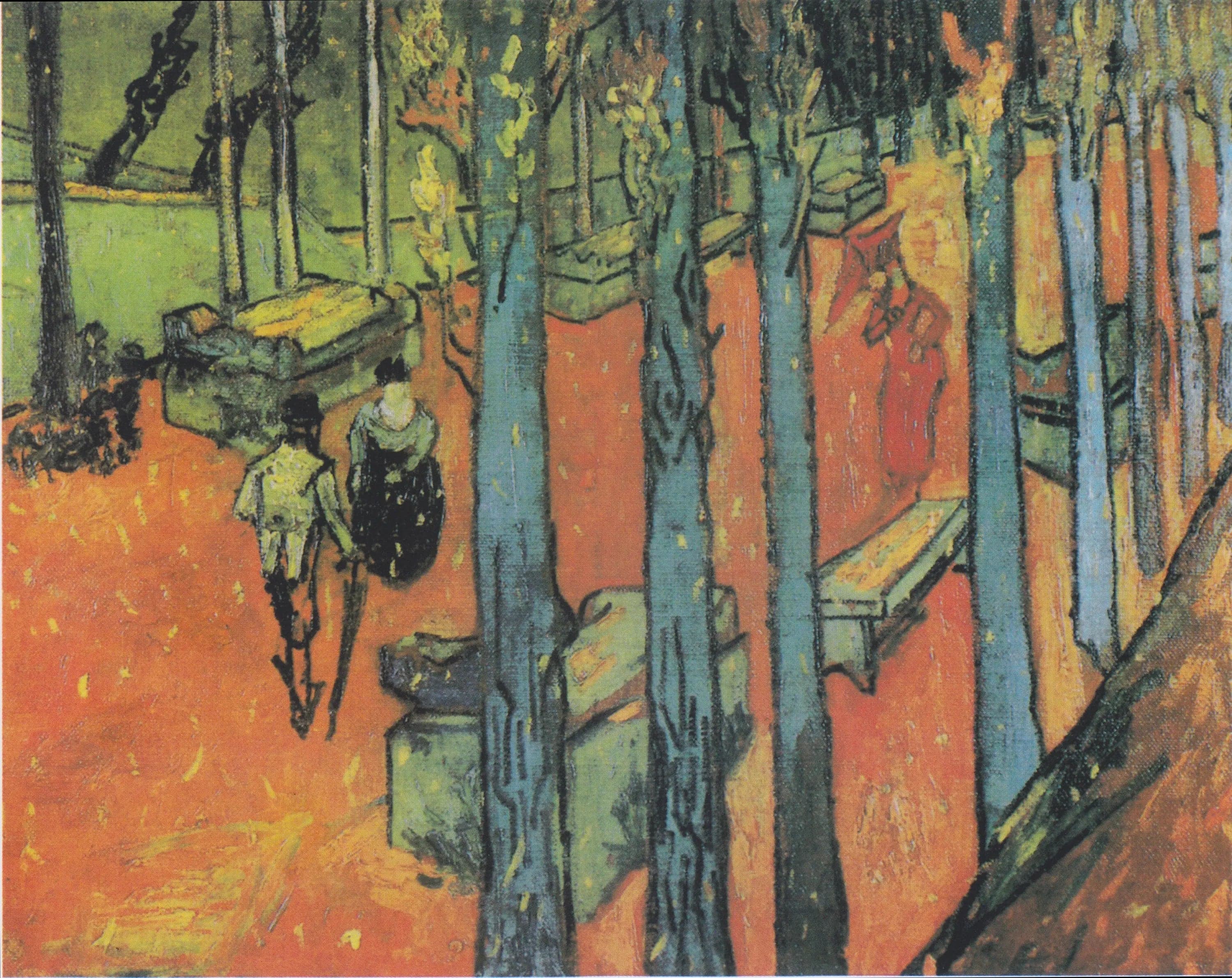
The Alyscamps: Autumn Leaves Falling
Scene depicted
In this pictorial work , the gradients of autumn leaves blend with the warmth of the lights of Arles , creating a poetic composition. The path of the Alyscamps, lined with plane trees, comes alive under a blue sky, each shade of yellow and orange weaving a story of transition and beauty that speaks to the viewer. Here, nature reveals itself in all simplicity, a reflection of an ephemeral season, yet eternal in its memory.
Historical context
Created in 1888, in Arles , this painting is part of the post-impressionist movement, a time when Vincent van Gogh sought to capture the vibrant essence of light and color. Currently, this iconic canvas is preserved at the Kröller-Müller Museum , measuring 92 x 73 cm, reflecting the richness of the artistic environment in which it was created.
Place in the artist's career
Les Alyscamps: Falling Autumn Leaves represents a key period in Van Gogh's career. It is in Arles , a true haven of peace for him, that he reaches a stylistic peak. Compared to other masterpieces like The Starry Night and The Sunflowers , this painting shows a marked technical evolution characterized by the bold use of color, and the expression of the emotions intrinsic to his subject.
Anecdote
“I seek to paint what I feel, the beauty of nature in its transformation.” These words resonate throughout his journey, where each brushstroke within the Alyscamps evoked a gentle melancholy, a noble simplicity. Van Gogh was inspired by the falling leaves, each color blending with memories of a golden autumn light, translating a palpable emotion into the painting itself.