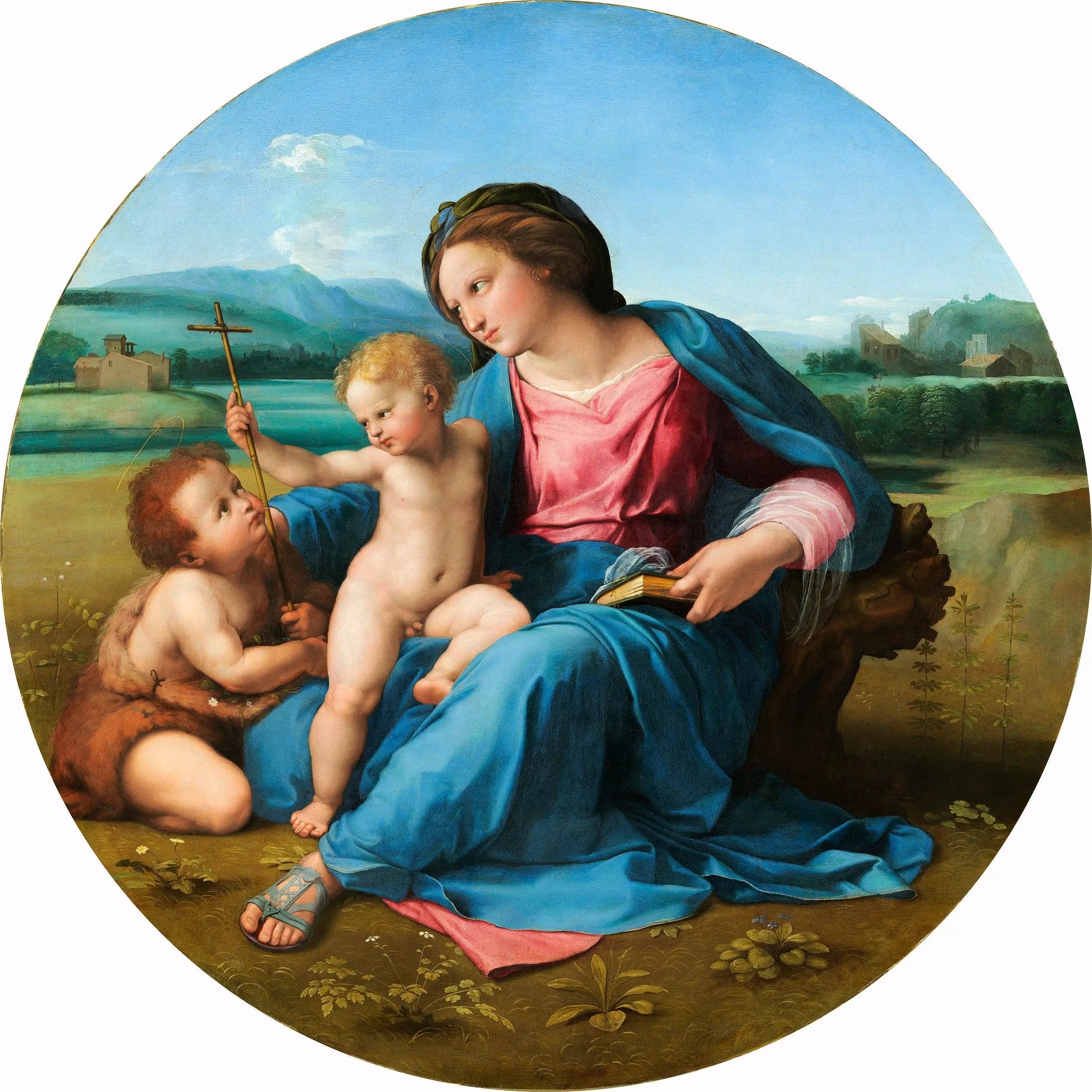
The Alba Madonna
- Original dimensions
- 98 x 98 cm
- Movement
- High Renaissance
- Museum
- National Gallery of Art
- Year
- 1511
Scene depicted
This sublime pictorial work shows the Virgin Mary holding the Child Jesus, surrounded by an aura of serenity and protection. The attention paid by Raphael to delicate expressions and clothing details reveals a visual narrative where compassion and tenderness unite, making The Madonna of Alba a true meditation on divine motherhood.
Historical context
Created in Florence, during the peak of the High Renaissance , The Madonna of Alba testifies to a time when art and spirituality intertwine with a unique power. This painting , a jewel of the collection of the National Gallery of Art , embodies the pinnacle of artistic innovation of its time, offering a window into the genius of Raphael Sanzio and his dazzling creative spirit.
Place in the artist's career
The Madonna of Alba stands as a major pillar in Raphael's career, marking a period when the artist merges elements of his youth with evident maturity. Alongside The Sistine Madonna and The Madonna of the Apple , this painting embodies the evolution of his style, revealing an increased mastery in the elevation of form and composition, while maintaining a touching sensitivity.
Anecdote
Raphael once confided: "Beauty lies in the softness of forms and the light playing on emotions." This sentiment inspired him, every morning in Florence, as the golden light illuminated the historic streets, awakening in him a desire to capture the angelic beauty and the softness of faces, as in The Madonna of Alba .