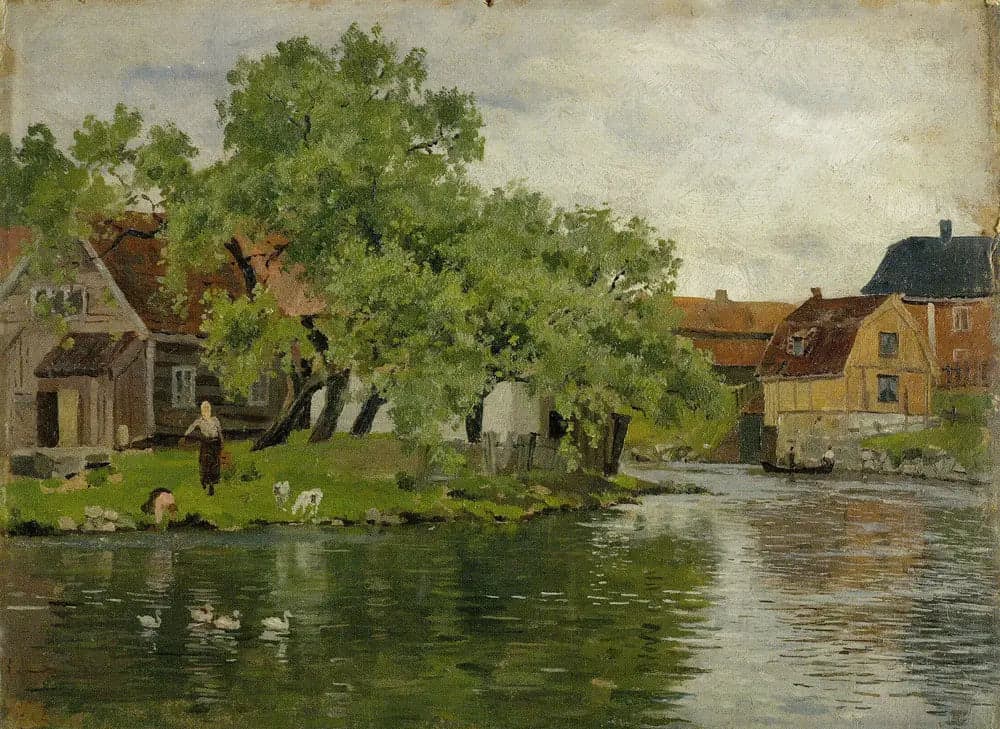
The Akerselva
- Original dimensions
- 31.5 x 23 cm
- Museum
- Not specified
- Year
- 1881
Scene depicted
In this canvas , the Akerselva river is depicted with immeasurable sensitivity. The calm waters meander through lush greenery, inviting contemplation. Munch, as a true maestro, composes a landscape that evokes both the tranquility of a suspended moment and the inner turmoil of the human soul, creating an atmosphere of connivance between nature and emotions.
Historical context
Created in 1881, this painting embodies its roots in Oslo, Norway, at the heart of an artistically rich era that gives birth to works influenced by symbolism and expressionism . In a dynamic cultural context, where artists explore the depths of human emotion, the canvas "L'Akerselva" stands out as a poignant illustration of the beauty of Norwegian nature, capturing the essence of an era while remaining a mystery in its current location.
Place in the artist's career
“L'Akerselva” fits into Munch's artistic journey as a key work, revealing his nascent stylistic maturity. At this time, the artist explores recurring themes of solitude and nature, alongside paintings such as “The Scream” and “The Madonna.” Each of these works marks a milestone in the evolution of his pictorial language, signaling a shift towards bolder and more emotional compositions.
Anecdote
“Inspiration often arises in the silence of misty mornings,” Munch might have said while recalling this precious moment of creation. Imagine a gentle morning by the Akerselva river, where light dances on the water, creating a living tableau for the artist. It is in this tranquility that the evocative power of the painting took shape, revealing the beauty that is both serene and troubled in its atmosphere.