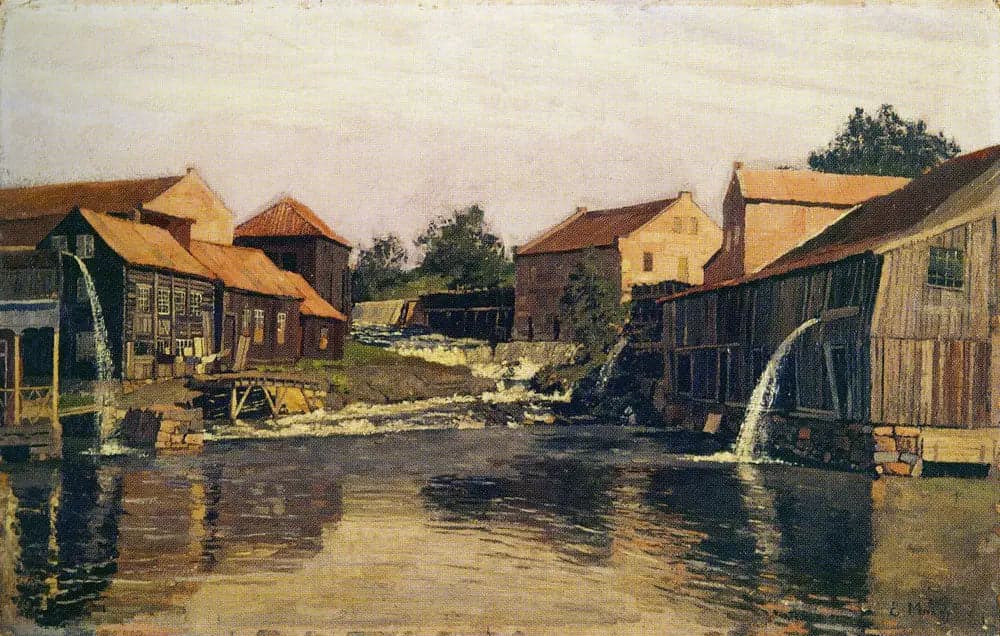
The Akerselva at Nedre Foss
- Original dimensions
- 60.5 x 38.5 cm
- Museum
- Not specified
- Year
- 1882
Scene depicted
In the painting “L'Akerselva à Nedre Foss,” Edvard Munch invites us to dive into an idyllic scene where the Akerselva river peacefully winds through a striking landscape of the city of Oslo. This pictorial work delicately depicts the reflections on the water, framed by lush vegetation, creating a perfect harmony between nature and urban tranquility. The chosen tones accentuate the serenity of the moment, capturing the imperceptible flow of time.
Historical context
Created in 1882, in Oslo, this iconic composition belongs to the expressionist movement, merging reality with pure emotion. The painting, measuring 60.5 by 38.5 cm, evokes a time when art no longer merely reproduced but sought to capture the essence of human experience. The work is currently held in a private collection, thus developing its mystical aura and rare accessibility.
Place in the artist's career
L'Akerselva à Nedre Foss represents an important milestone in Munch's career, fitting just before his major expressionist works. At this time, the artist was experimenting with light and color, alongside works like “The Scream” and “The Madonna,” which would mark his stylistic maturity. This painting illustrates the transition from a more traditional approach to a bolder visual exploration.
Anecdote
“Truth reveals itself in nature, between shadows and lights” could have said Munch one morning as he contemplated the sweetness of Nedre Foss. This canvas, born from a fleeting moment of inspiration, illustrates the poignant beauty of nature, capturing the glow of sunlight filtering through the foliage. The evocative power of L'Akerselva à Nedre Foss reminds us of the uniqueness of the moments that shape our perception.