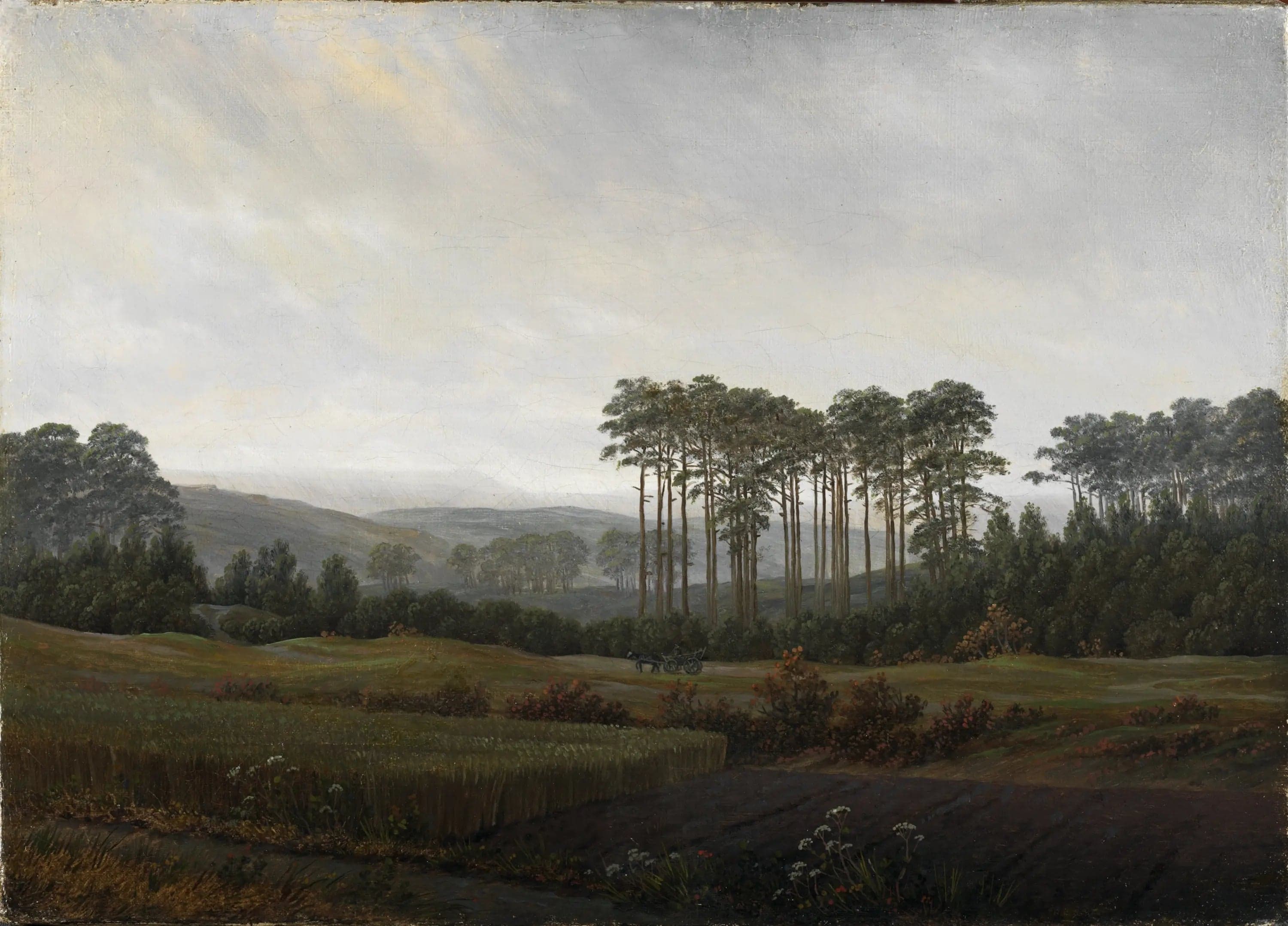
The Afternoon
- Original dimensions
- 30.5 x 22 cm
- Museum
- Lower Saxony State Museum
- Year
- 1821
Scene depicted
In this pictorial work, a delicate light bathes a serene landscape, where nature unfolds majestically. Tall trees blend with the clear sky, while a winding path invites exploration. This painting depicts a suspended moment, where the viewer can feel the discreet sounds of nature: the song of birds, the rustling of leaves. An atmosphere of tranquility settles in, offering a welcome escape to a world imbued with poetry.
Historical context
Created in 1821, this iconic painting is rooted in the dawn of the romantic movement, at a time when art begins to explore the depth of the human soul. Caspar David Friedrich , a leading figure of this era, managed to capture landscapes imbued with melancholy and contemplation. His painting "The Afternoon" now resides in the prestigious Lower Saxony State Museum , a witness to this era where the sublime mingles with the everyday.
Place in the artist's career
“The Afternoon” is situated at a crucial turning point in Friedrich's career, marking a transition to artistic maturity. This painting can be paralleled with “ The Wanderer above the Sea of Fog ” and “The Sea Grave,” allowing for a tracing of both technical and emotional evolution. Introspection and the search for the infinite become central themes, cementing Friedrich as a master of romanticism .
Anecdote
“I seek to paint not what I see but what I feel,” Friedrich reportedly said one day, capturing the essence of his masterpiece. Inspired by a sweet and nostalgic afternoon, he succeeded in weaving a canvas where the whisper of the wind and the dance of shadows evoke a sense of eternity. Every detail of this painting is the producer of an emotional journey, a call to reconnect with oneself and the beauty of the world.