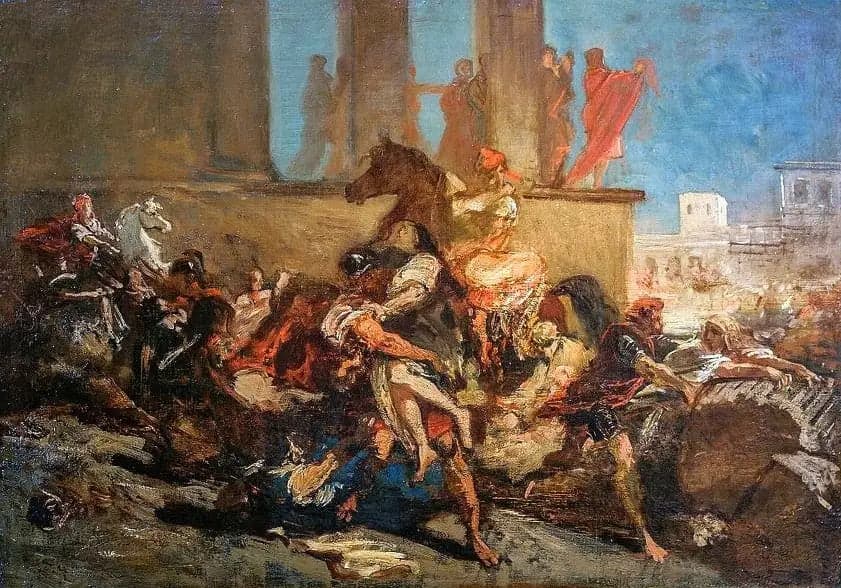
The Abduction of the Sabine Women.
- Original dimensions
- 69.5 x 48.5 cm
- Museum
- Wawel Castle
- Year
- 1850
Scene depicted
This iconic painting illustrates the tragic events surrounding the abduction of the Sabine women by Romulus and his companions, a fundamental tale of Roman mythology. The representation of the dynamics between the protagonists, between anger and desire, testifies to Delacroix's artistic genius. Every face, every gesture is a visual narrative where movement becomes language and emotion overflows from the painting .
Historical context
Created in 1850, the painting "The Abduction of the Sabine Women" finds its roots in the tumultuous context of 19th century France, a time marked by political upheaval. Eugène Delacroix , an iconic figure of the Romantic movement, skillfully merged human emotions with historical scenes. The canvas , which now resides at Wawel Castle in Poland, measures 69.5 x 48.5 cm, embodying the grandeur of its time.
Place in the artist's career
"The Abduction of the Sabine Women" represents a crucial milestone in Delacroix's career. This masterpiece embodies a stylistic evolution towards a more assertive Romanticism. When compared to other works such as " Liberty Leading the People " and " The Massacre at Chios ", one can observe the growing mastery of light and color, as well as an increasingly marked emotional depth.
Anecdote
"Passion is what gives life to a work ." said Delacroix, reminding us of the intensity with which he experienced every creative moment. The scene of "The Abduction of the Sabine Women" was partly inspired by a walk through the streets of Paris, mingled with the cries of children and the bursts of spring light. It is in this symbiosis of sensations that the canvas took shape, capturing the essence of human passion.