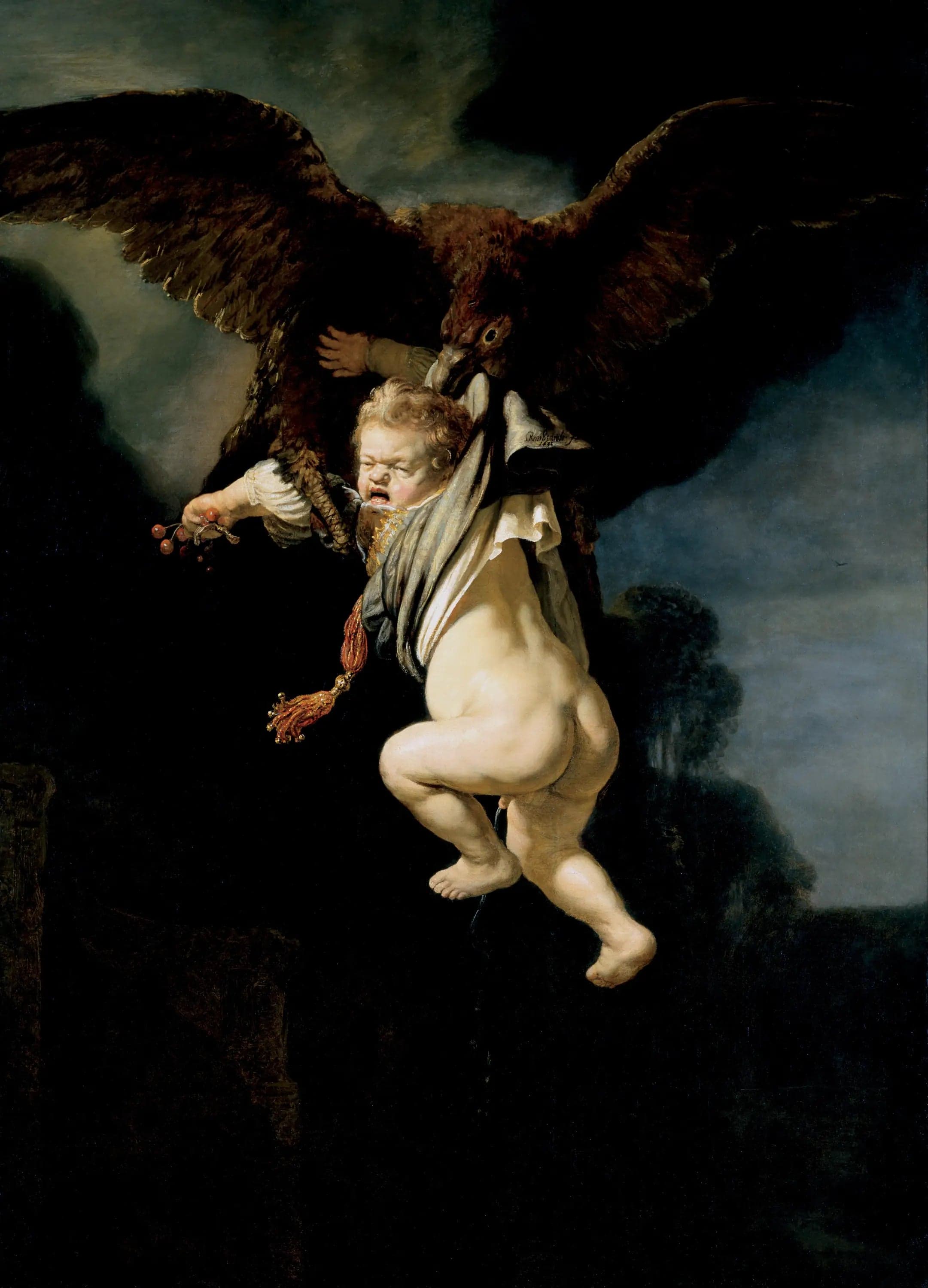
The Abduction of Ganymede
- Original dimensions
- 129 x 177 cm
- Movement
- Dutch Golden Age of painting
- Museum
- Gemäldegalerie Alte Meister Dresden
- Year
- 1635
Scene depicted
Ganymede's Rape depicts the mythic moment when Jupiter, in the form of a majestic eagle, abducts young Ganymede to Olympus. The Rembrandt painting is imbued with a tragic romanticism, where the power of divine love confronts human vulnerability. The gestures and expressions of the figures make the scene both vibrant and poignant.
Historical context
Work : Ganymede's Rape |BRK| Artist : Rembrandt |BRK| Year : 1635 |BRK| Museum : Gemäldegalerie Alte Meister Dresden |BRK| Dimensions : 129 x 177 cm |BRK| Artistic movement : Dutch Golden Age of painting |BRK|
Place in the artist's career
This painting positions itself as a pinnacle of Rembrandt 's career, a testament to his genius and technical mastery. It falls between his earlier works, such as The Night Watch, where chiaroscuro was essential, and his later works, like The Anatomy Lesson, where he explores deep emotional nuances. Ganymede's Rape, with its bold use of light and color, represents an evolution towards greater expressiveness.
Anecdote
“In every brushstroke, I seek to give life to the soul of my models,” said Rembrandt while painting Ganymede's Rape on a spring morning. Inspiration came from the golden light filtering through his studio, infusing warmth and depth into this canvas . It was at that moment that the artist knew this painting would be an emotional exploration of beauty and passion.