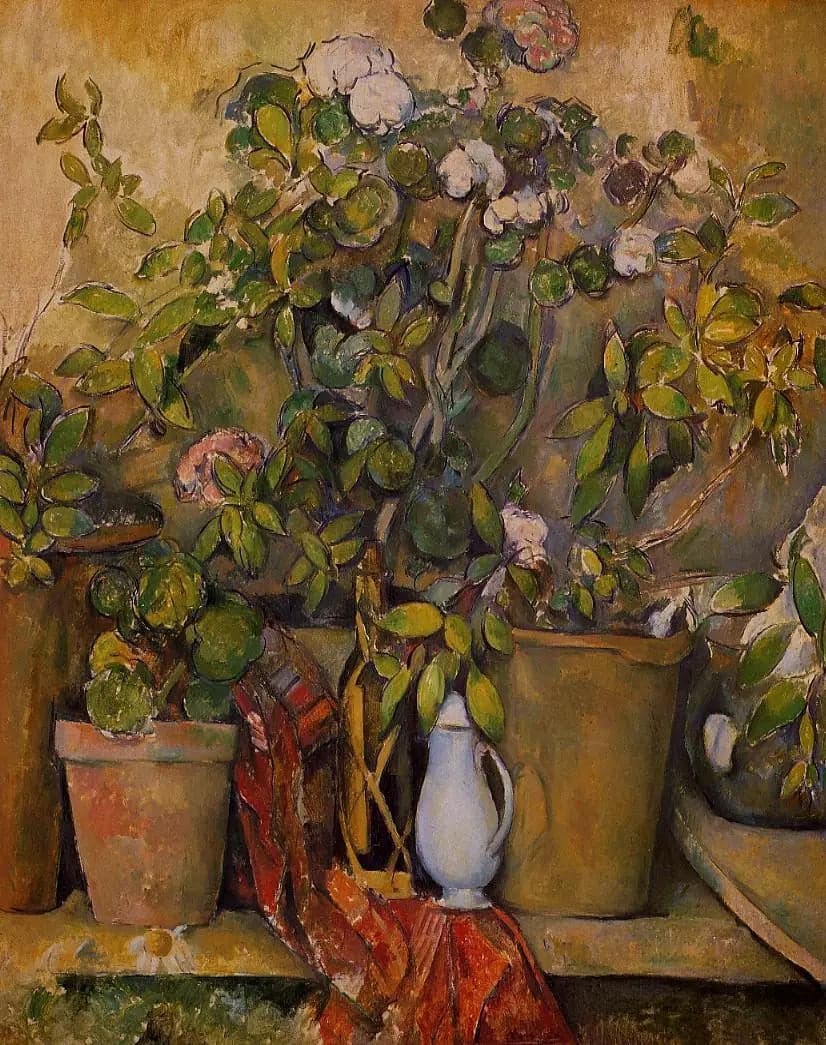
Terracotta pots and flowers
- Original dimensions
- 73.3 x 92.1 cm
- Museum
- Barnes Foundation
- Year
- 1891
Scene depicted
This painting, of exquisite beauty, captures the delicate simplicity of the vibrant flowers arranged in pots en terre cuite. A true ode to nature, it evokes a sensory interpretation of the everyday. The shapes and colors dance together, inviting the viewer to feel the sunlight caressing each petal, revealing the tranquility of a suspended moment.
Historical context
Created in 1891, this painting is emblematic of the borders of Provence, a region from which Cézanne hails. Its affiliation with the Impressionist movement, while foreshadowing Cubism , illustrates the stylistic transition of the 19th century towards modernity. Today, this precious canvas is preserved at the Barnes Foundation , where it attracts art enthusiasts from around the world.
Place in the artist's career
This masterpiece marks a turning point in Cézanne's career, positioned between the discovery of nature and the affirmation of a personal style. At this time, Cézanne created other remarkable compositions such as "Les Grandes Baigneuses" and "Nature morte aux pommes", where this same quest for structure and volume can be found, reflecting a growing technical mastery.
Anecdote
“I want to create paintings that speak more to the hearts than to the eyes.” This is an excerpt from a profound reflection by Cézanne. It is said that he was inspired on a gentle spring morning, sitting in his garden, surrounded by pots en terre cuite and vibrant flowers. This moment of contemplation is palpable in the evocative strength of this canvas .