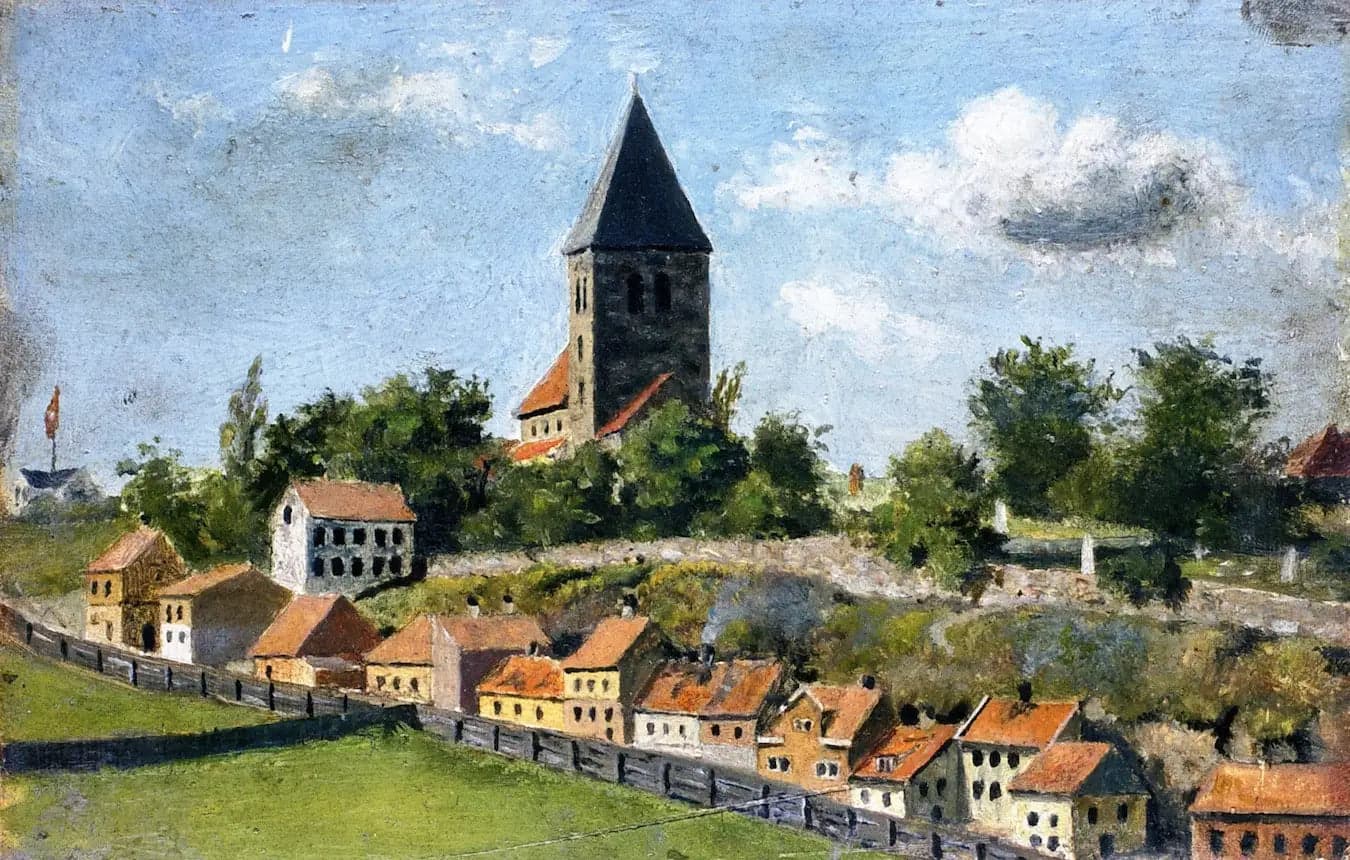
Telthusbakken with the Old Church of Aker
- Original dimensions
- 18 x 12 cm
- Museum
- Not specified
- Year
- 1880
Scene depicted
The composition of Munch reveals a soothing panorama, where the church and ancestral houses blend into the landscape. The scene, imbued with calm and harmony, invites the viewer to explore the layers of shared history and the feelings of nostalgia that accompany it. Munch's art, here, testifies to an era, an atmosphere, and a palpable humanity.
Historical context
Created in 1880, this painting evokes a time rich in changes, in the city of Oslo, Norway, reflecting the symbolist movement. Through the alleys of Telthusbakken, Munch captures the essence of a vibrant community, with the silhouette of the old church of Aker rising majestically, bearing witness to local history. This canvas is a precious legacy of Norwegian art, although it is not currently displayed in any known public museum.
Place in the artist's career
This painting marks a turning point in Munch's career, which can be analyzed alongside his flagship works, “The Scream” and “The Madonna.” While the latter two express intense and tormented emotions, the painting of Telthusbakken reveals a calmer and more introspective facet, reflecting his stylistic evolution towards a more serene exploration.
Anecdote
“Nature and memory intertwine in every brushstroke.” This is how Edvard Munch evokes his inspiration. One can imagine the artist strolling in the early morning, the rising sun brushing the rooftops of the buildings, capturing that moment of wonder where past and present meet. This primal connection nourishes the evocative power of his painting .