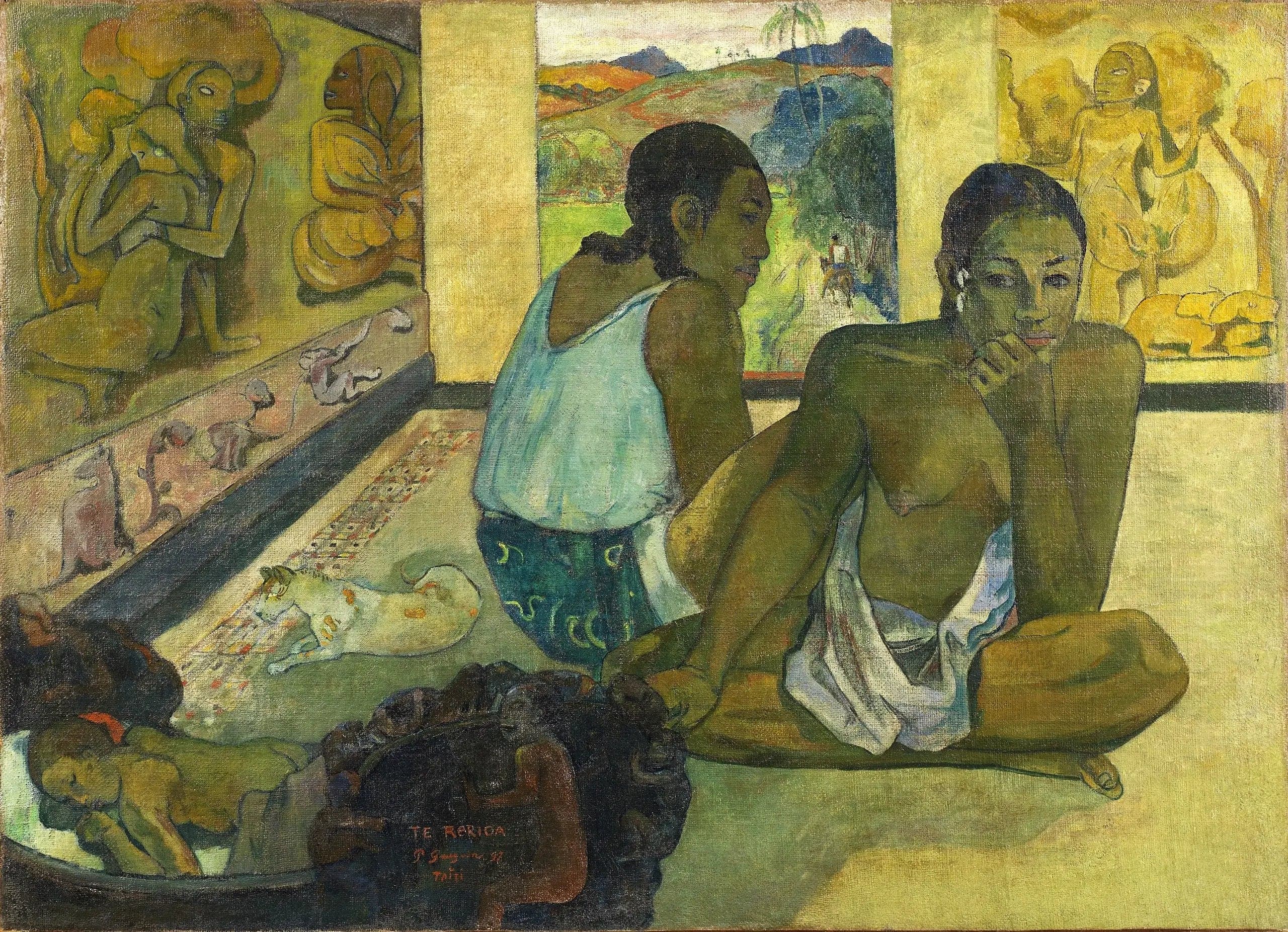
Te Rerioa
- Original dimensions
- 130.2 x 95.1 cm
- Museum
- Courtauld Gallery
- Year
- 1897
Scene depicted
At the heart of the painting “Te Rerioa,” the artist captures a woman, veiled in mystery, alongside a child, giving the scene an atmosphere both imbued with serenity and introspection. The composition of this tableau evokes the spiritual dimension of life in Tahiti, between dream and reality, celebrating the harmony between man and nature.
Historical context
This painting emblematic was created in 1897, in the heart of French Polynesia, a kingdom of inspiration for Paul Gauguin . Enthusiastic about the post-impressionist movement, Gauguin captures through this painting an essence of exoticism and pure emotion. Currently, it is displayed at the Courtauld Gallery , a showcase amidst an impressive collection.
Place in the artist's career
Considered one of the major works of his career, this tableau represents a striking artistic evolution. Placing Gauguin in a period of maturity, it is interesting to compare it to other works such as “Vision after the Sermon” and “La Orana Maria,” each revealing distinct facets of his creative journey.
Anecdote
“I do not paint what I see, but what I feel.” It is in an atmosphere of tropical warmth, during a morning tinged with soft light, that Gauguin was inspired to create his masterpiece . He was amazed by the lush nature and local culture, an emotion that transpires in every brushstroke of this canvas .