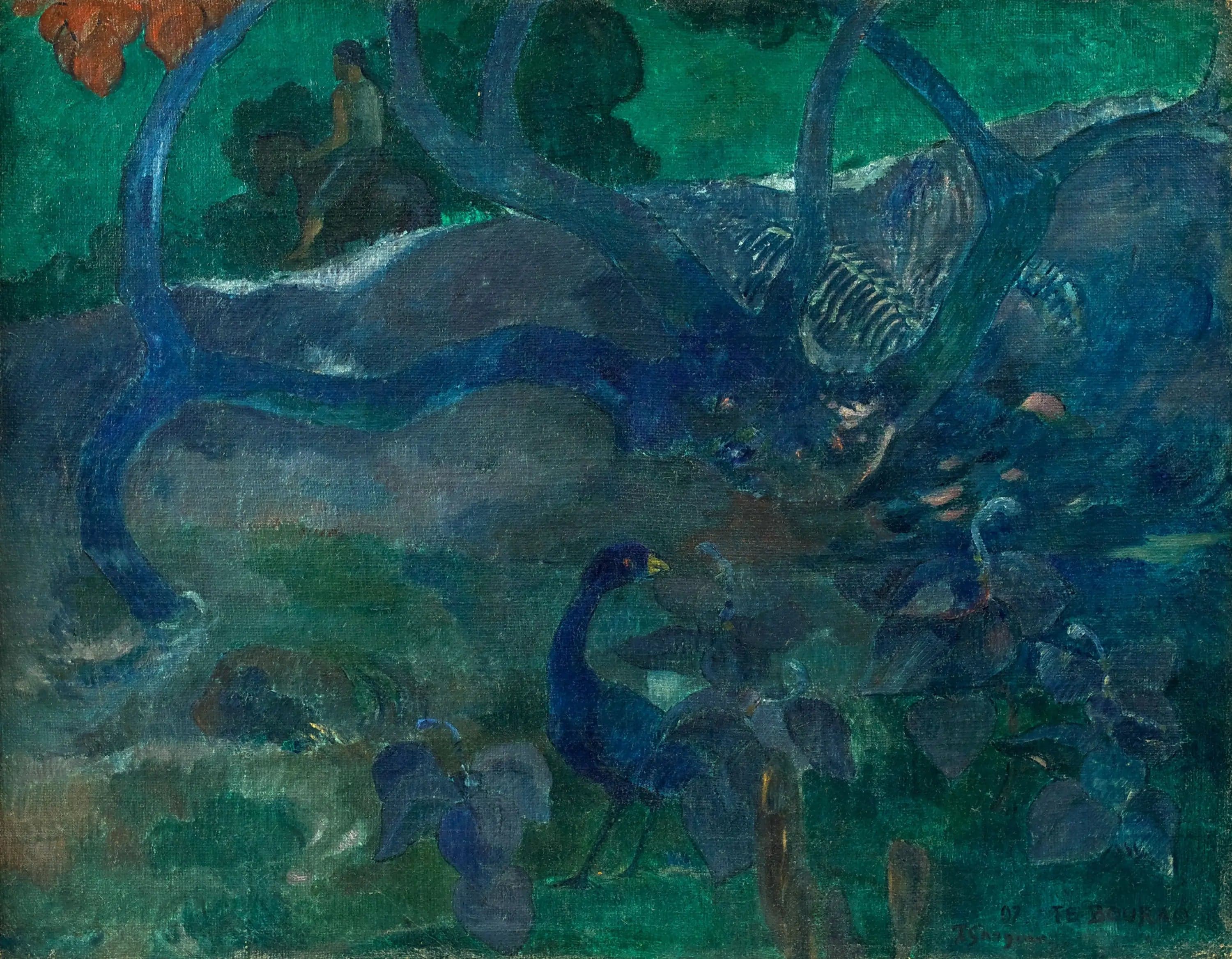
Te Bourao II
- Original dimensions
- 92 x 73 cm
- Museum
- Not specified
- Year
- 1897
Scene depicted
In this striking composition, Gauguin captures the essence of a frozen moment. Two human figures, motionless, seem to converse in a world where colors vibrate to the rhythm of nature. The earth, saturated with green, and the sky, tinged with subtle blues, come together to form a painting with soft lines full of mystery. Each curve and hue tells a story, that of a deep bond between the artist and his environment.
Historical context
Created in 1897, Te Bourao II is set in a rich geographical and historical framework, tinged with the lights and shadows of Tahiti, the ultimate destination of the French painter. This pictorial work belongs to the symbolist movement, where color and form exalt intuition and emotions. The painting, not yet integrated into a known museum collection, spans impressive dimensions of 92 x 73 cm, thus evoking the intensity of Gauguin's artistic vision.
Place in the artist's career
Te Bourao II represents a turning point in Gauguin's career. After his beginnings in Paris, he turned to the exploration of uncharted territories, both geographical and stylistic. Alongside his other masterpieces such as Vision after the Sermon and The Beautiful Angèle , this work symbolizes his creative peak, blending emotion and spirit with a pronounced technicality.
Anecdote
Paul Gauguin often said: "I make my canvases to cry, to scream, to love, to speak, to be beautiful." It was in the golden light of a Tahitian morning that the idea of Te Bourao II came to life. Facing the sea, a breath of inspiration overwhelmed him. The soul of the place, imbued with wild beauty, mingled with his spirit, making this painting deeply evocative.