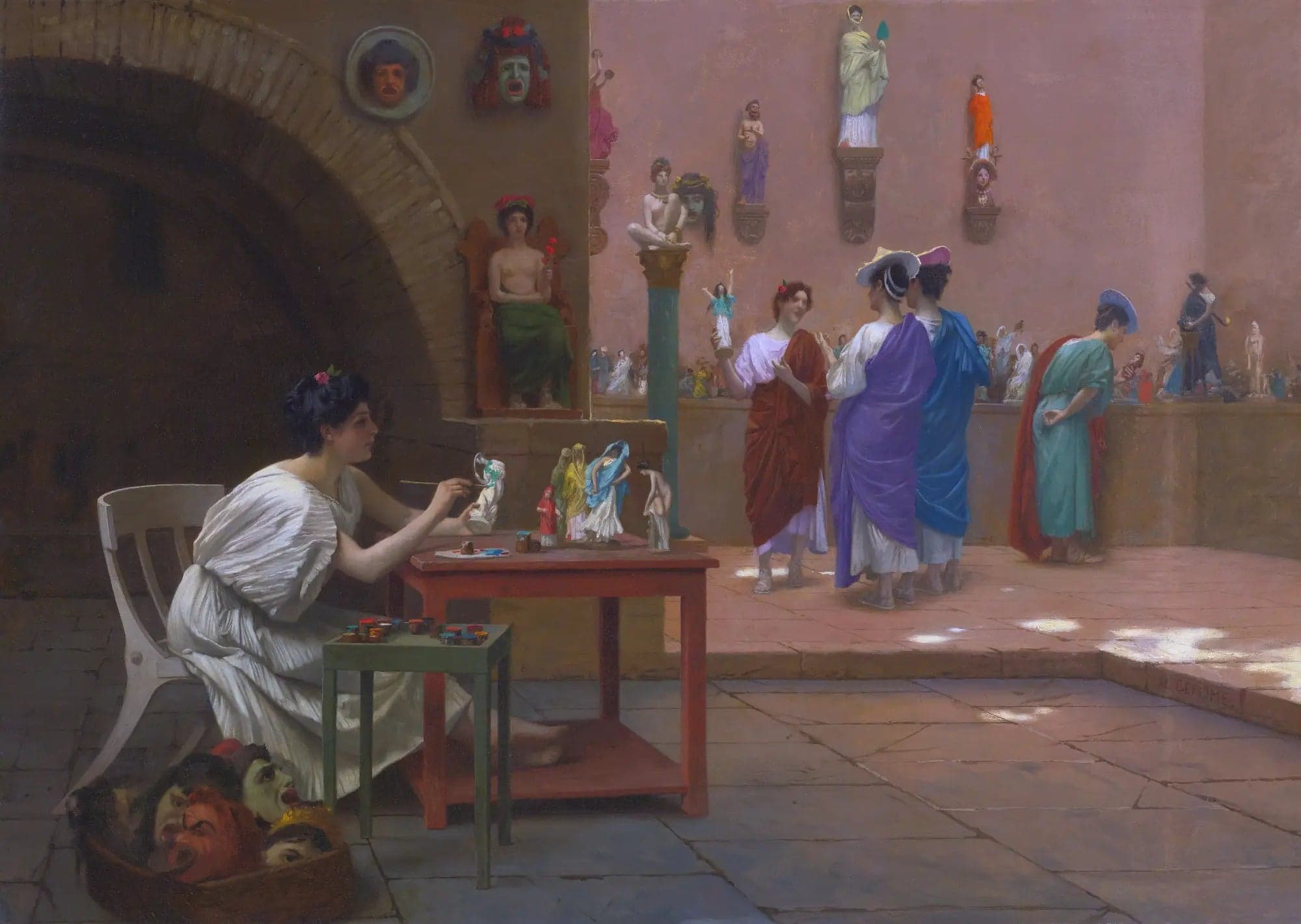
Tanagra Workshop - Jean
- Original dimensions
- 91.1 x 64.4 cm
- Museum
- Not specified
- Year
- 1893
Scene depicted
The painting “Atelier de Tanagra” is an ode to the art of pottery, depicting artisans at work, delicately shaping terracotta figurines. This scene reveals the harmony between man and matter, inviting the viewer to explore the beauty of ancestral craftsmanship and the vibrancy of colors that engage in an enchanting dance on the canvas .
Historical context
Created in 1893, this painting embodies its essence in the artistic context of the crowning of realism , at the peak of the 19th century. Jean-Léon Gérôme , maestro of the time, offers with his painting a visual panorama that transcends time in the city of Paris, where art and innovation intertwine. Although the painting is no longer exhibited in a specific museum, it remains accessible to art enthusiasts through private collections.
Place in the artist's career
“Atelier de Tanagra” is situated at a pivotal moment in Gérôme's career, attributed to his maturity period where he merges technical skill and emotion. With works such as “Pollice verso” and “The Duel after the Ball” he unveils a refined style, demonstrating a palpable evolution both in composition and in painting technique.
Anecdote
“Inspiration hides behind every face encountered in a Parisian street. It is often in simplicity that beauty is concealed.” This quote from Gérôme evokes the sunny morning when he sketched the idea for his masterpiece . The studio then becomes a creative sanctuary, where the canvas comes to life under the captivating nuances of light.