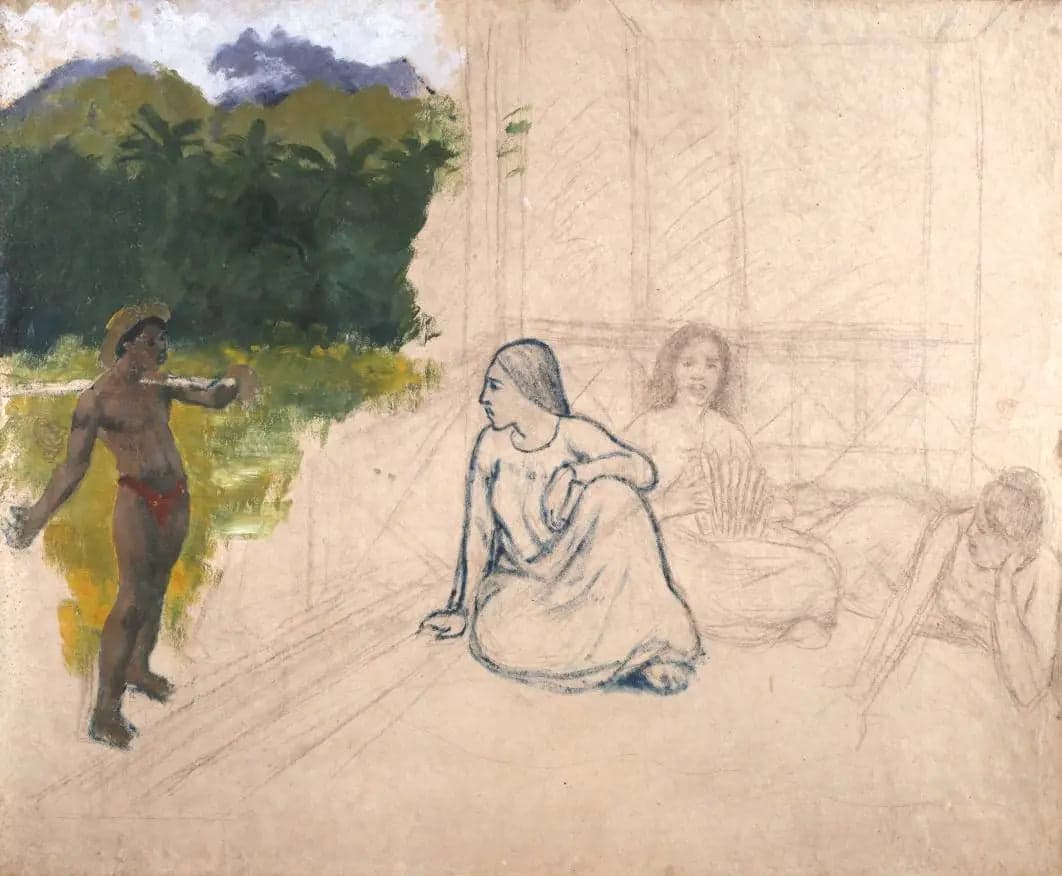
Tahitians, or Tahitian Women at Rest
- Original dimensions
- 1019 x 854 cm
- Museum
- Tate Modern
- Year
- 1891
Scene depicted
This painting immerses us in a moment of absolute calm. The figures of the Tahitians, delicately placed on the ground, surrounded by lush and colorful vegetation, evoke a moment of sweetness and sharing. Each element of the composition seems to whisper a legend, a story, a passage from the daily life of its inhabitants, while celebrating the simplicity of island existence.
Historical context
Created in 1891 in the heart of the enchanting landscapes of Tahiti, this canvas is emblematic of the Nabis artistic movement, which expresses a spiritual quest through color and form. This pictorial work currently resides in the Tate Modern in London, where it continues to amaze the public with its imposing dimensions and singular beauty.
Place in the artist's career
Tahitians, or Tahitian Women at Rest is part of Gauguin's second Tahitian period, where the artist moved towards increasing abstraction, marked by a vibrant style. In parallel, works such as Vision of the Feast of the Bay of Javel and The Yellow Christ testify to his evolution towards bolder explorations of colors and feelings.
Anecdote
Gauguin, fascinated by the wild beauty of Tahiti, reportedly declared: "I seek simplicity, the authenticity of the human soul in these aerial landscapes." One enchanting morning, as he contemplated the sunny horizon, he is said to have seen the Tahitians at rest, embodying a magnetic serenity that would nourish his masterpiece of life scenes suspended in time.