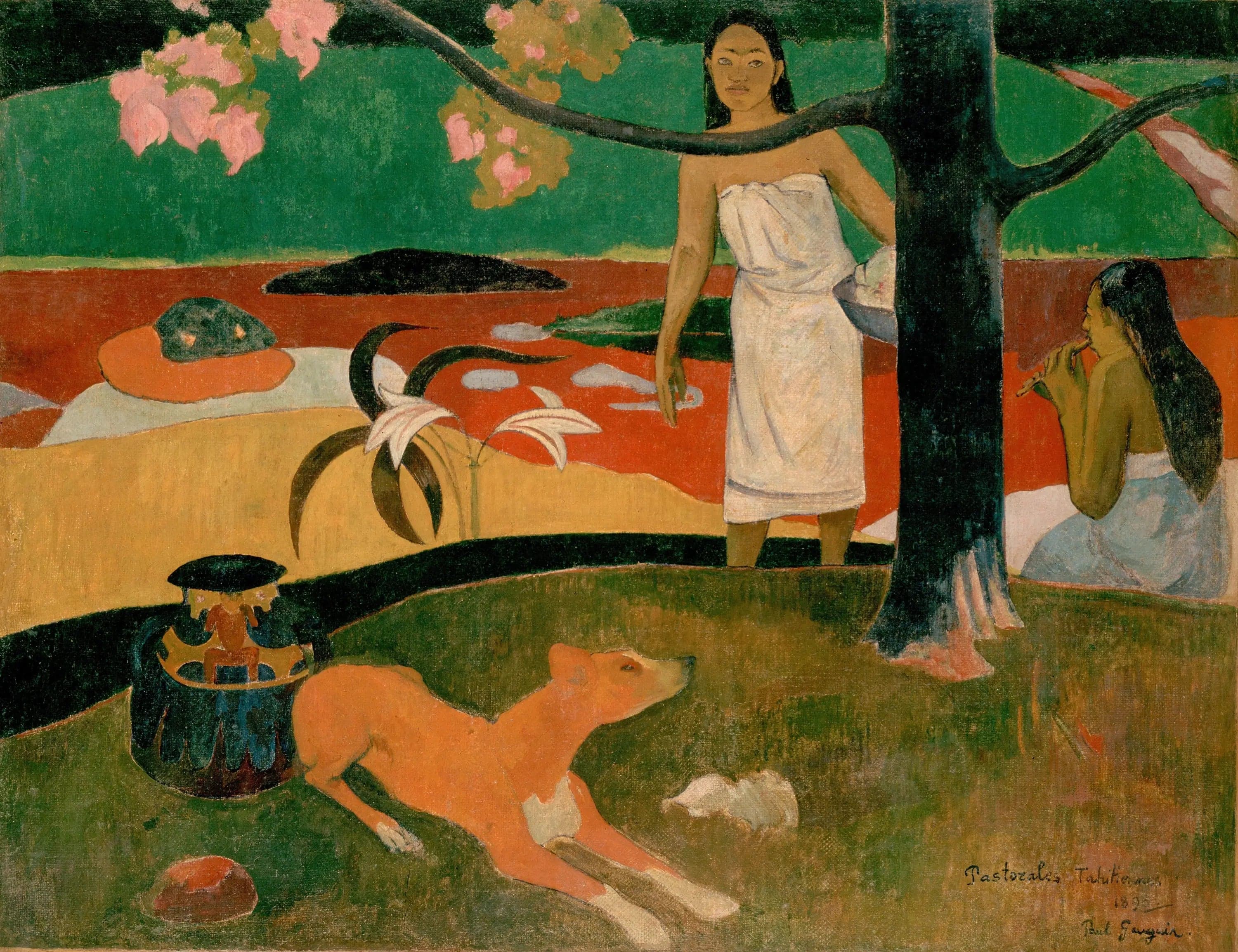
Tahitian Pastorals
- Original dimensions
- 113.7 x 87.5 cm
- Museum
- Hermitage Museum
- Year
- 1892
Scene depicted
The painting “Tahitian Pastorals” immerses us in a world where nature and man intertwine. The Tahitian women, serene and majestic, seem to harmonize with the fertile land. The vibrant palette and organic forms capture the essence of island life, a true hymn to natural beauty and rediscovered simplicity.
Historical context
Painted in 1892, this iconic work by Paul Gauguin marks a major milestone of the Post-Impressionist movement. It was born in the artistic effervescence of the late 19th century, in a context of both geographical and spiritual exploration. Currently, the painting is housed at the Hermitage Museum in Saint Petersburg, where it is admired for its impressive dimensions and narrative brilliance.
Place in the artist's career
This painting sits at a crucial crossroads in Gauguin's career, marking a period of stylistic and emotional renewal. Alongside “Vision After the Sermon” and “The Yellow Christ,” “Tahitian Pastorals” testifies to a growing evolution towards colorful expression, revealing an artist in full maturity.
Anecdote
“Color is a silent but captivating language.” This quote, inspired by Gauguin's artistic intuition, evokes the morning light on Tahiti, where he drew his inspiration. Contemplating the canvas, one feels the echo of that fleeting moment, imbued with light and softness, which the masterpiece immortalizes forever.