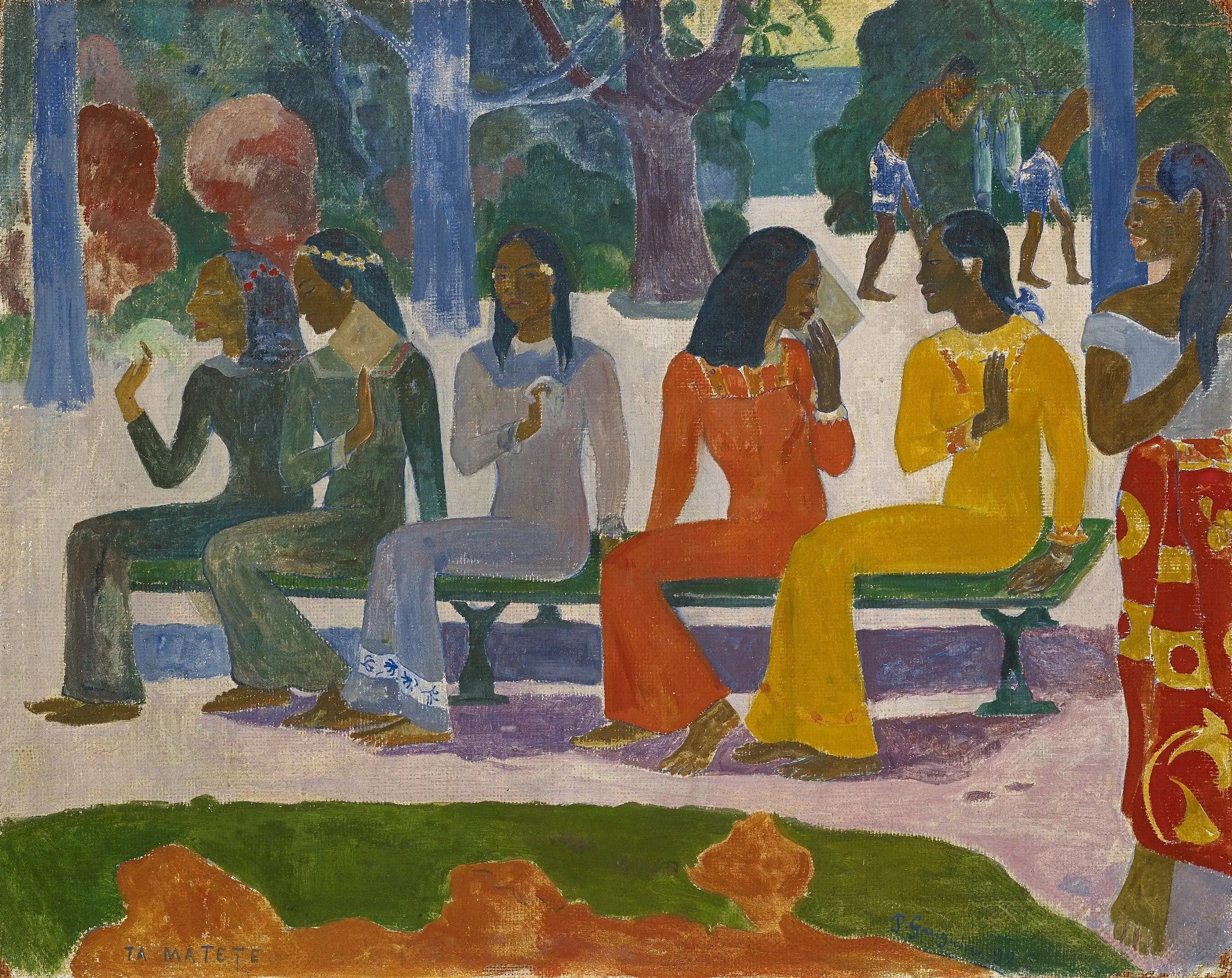
Ta Matete
- Original dimensions
- 92 x 73 cm
- Movement
- post impressionism
- Museum
- Kunstmuseum Basel
- Year
- 1892
Scene depicted
In this canvas , we discover the magnificent landscapes of Polynesia, where Gauguin infused his works with his passion for the land and its people. The scene depicts a woman with fruits, offering a rich representation of local culture, vibrant with energy and bright colors, revealing the sweetness of a suspended moment.
Historical context
Created at the end of the 19th century in 1892, Ta Matete is part of the artistic movement of post impressionism , reflecting a return to emotion and color. Paul Gauguin , in search of new sensations, painted this captivating work in Pont-Aven, Brittany. Today, the painting is carefully preserved at the Kunstmuseum Basel, a showcase for this enchanting painting that measures 92 x 73 cm.
Place in the artist's career
Ta Matete represents a turning point in Gauguin's career, a moment when he dared to break away from conventions to explore his own vision. Alongside Vision after the Sermon and The Yellow Christ , this painting highlights his evolution towards a freer expression, marked by bold colors and a rich symbolism .
Anecdote
“Colors speak, even without words.” These words from Gauguin resonate deeply through his masterpiece Ta Matete . Imagine a trade wind morning, where the shades of nature came together to inspire the artist. Amid the soothing sounds of the sea and the scents of exotic flowers, a magnificent vision took shape under his brush, creating an unforgettable pictorial work.