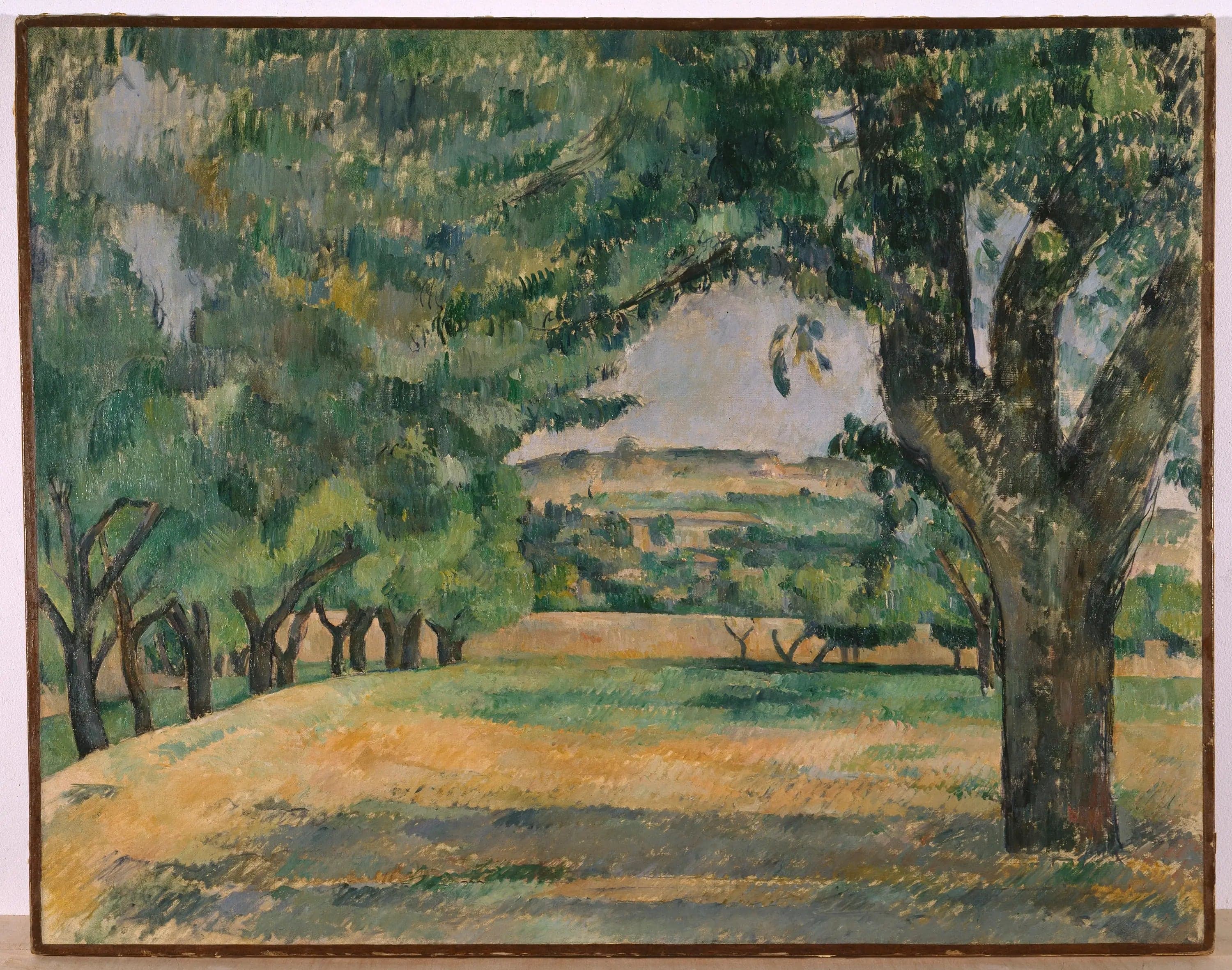
Surroundings of Jas de Bouffan
- Original dimensions
- 81 x 65 cm
- Museum
- Solomon R. Guggenheim Museum
- Year
- 1885
Scene depicted
In the canvas “Environs du Jas de Bouffan,” Cézanne transports us to the heart of a rural landscape, where lush fields stretch as far as the eye can see, adorned with proudly standing cypress trees. This canvas illustrates not only the topography of Provence but also captures the harmony held between the sky and the earth through the seasons. Light pours over the landscape, transforming every shade of green into a festival of vibrant colors.
Historical context
Created in 1885 in the peaceful region of Aix-en-Provence, this painting is at the heart of the post-impressionist movement. The canvas evokes a vibrant Mediterranean atmosphere, where nature, an integral part of the landscape, stands as Cézanne's muse. Today, this iconic canvas rests in the magnificent collections of the Solomon R. Guggenheim Museum , embracing its role as an icon within the global artistic heritage.
Place in the artist's career
“Environs du Jas de Bouffan” gracefully fits into Cézanne's flourishing career, marking a period of deep introspection and stylistic evolutions. This canvas juxtaposes with other works like “La Montagne Sainte-Victoire” and “Les Grandes Baigneuses,” highlighting his transition towards increasingly geometric and abstract compositions.
Anecdote
“Nature, I explore it. Each brushstroke brings my heart closer to these precious landscapes.” In this quest for authenticity, one spring morning, Cézanne stood before the striking beauty of the surrounding hills, the light and fragrant breeze of flowers intertwined with the sounds of birdsong, a scene that inspired this iconic painting . The masterpiece born from this communion between the artist and his environment overflows with a unique evocative power.