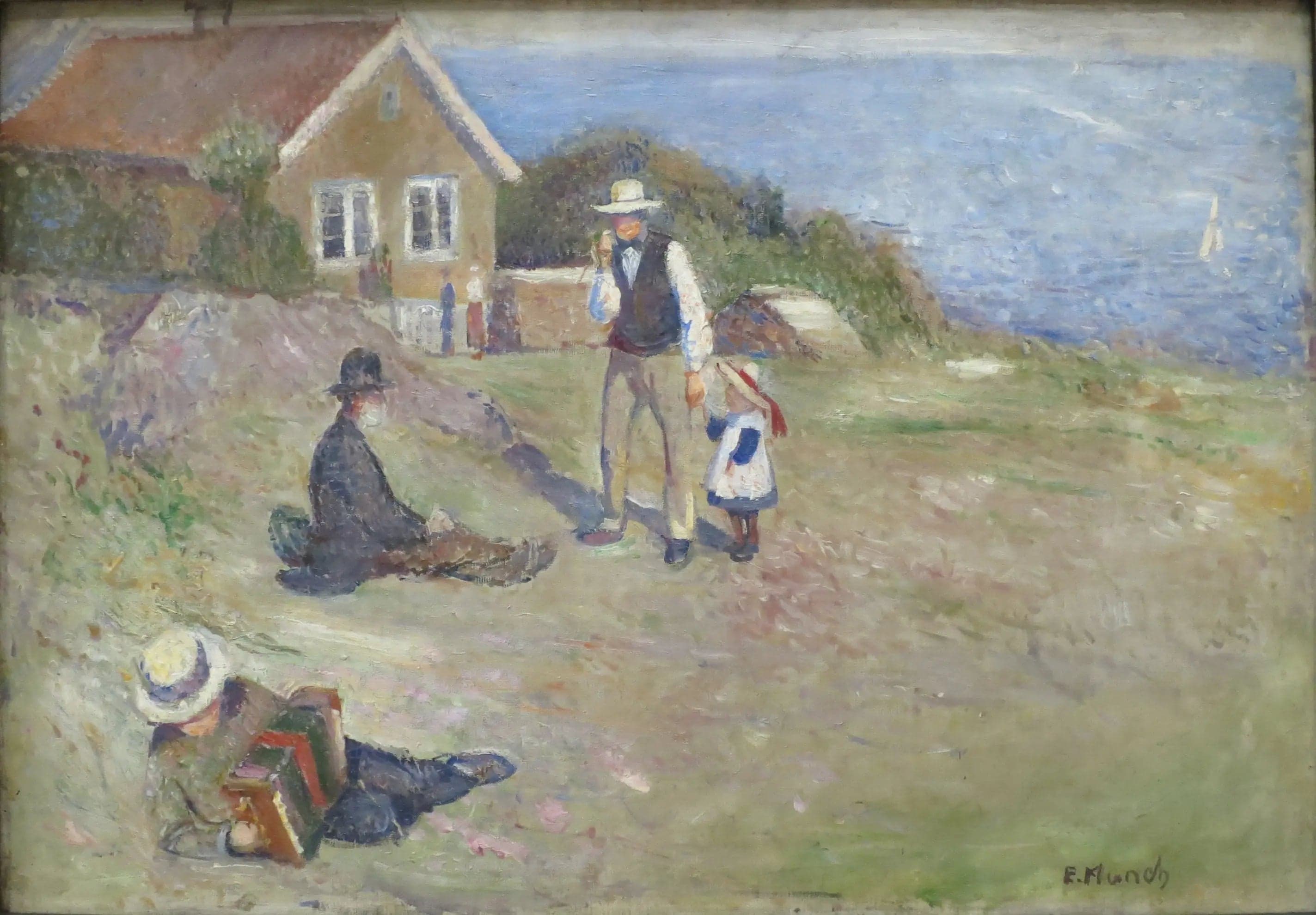
Sunday in Åsgardstrand
- Original dimensions
- 87.8 x 59 cm
- Museum
- Bergen Art Museum
- Year
- 1891
Scene depicted
In this painting , Munch depicts a scene of summer leisure, where figures move lightly along the shore, bathed in the warmth of golden light. Their peaceful silhouettes, welcomed by the clear blue of the sea, evoke the sweetness of a simple life, revealing a fragile tranquility of existence.
Historical context
Created in 1891, in the picturesque town of Åsgardstrand, this painting is part of the Symbolist movement, foreshadowing the expressionism dear to Munch. This painting, now preserved in the Bergen Art Museum, flourishes within a historical framework where art resonates with Danish nature, capturing the peaceful moments of a Sunday on the beach. It is through its dimensions of 87.8 x 59 cm that the work asserts itself, promising a sensory journey.
Place in the artist's career
Sunday in Åsgardstrand represents a key phase in Munch's career, a turning point towards a more intense exploration of human emotions. By relating it to The Scream and The Madonna, one observes a marked stylistic evolution characterized by a search for introspection and psychological depth, transforming each painting into a mirror of the soul.
Anecdote
“Art should be like a light, illuminating buried feelings.” It was by sharing a sunny day with childhood friends, rocked by the gentle sound of waves and the scent of wildflowers, that Edvard Munch drew his inspiration for this masterpiece . Every brushstroke, every shadow in the painting contains this vibrant emotion.