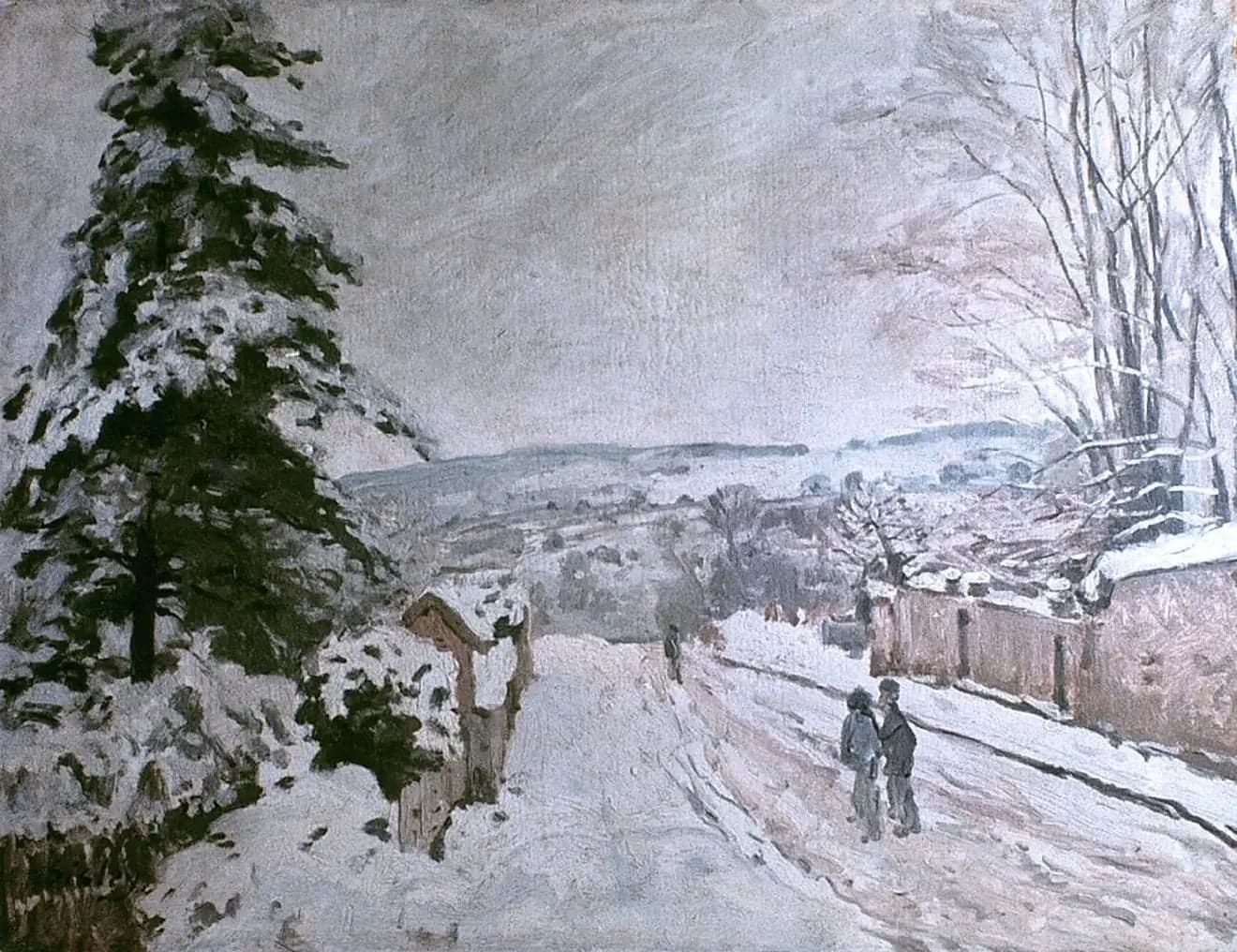
Street of the Flying Heart in Louveciennes
- Original dimensions
- 38 x 22 cm
- Museum
- Not specified
- Year
- 1872
Scene depicted
The painting “Rue du Cœur Volant à Louveciennes” evokes a peaceful alley, where nature coexists harmoniously with architecture. Sisley, through his mastery of the brush, captures the softness of the light on the cobblestones, placing the viewer at the heart of a radiant and serene future. This movement imbued with freshness and joy of living enhances the simplicity of French landscapes, instilling a sense of calm and happiness.
Historical context
Created in 1872, this canvas comes to life in the picturesque commune of Louveciennes, an iconic place in the Paris region. Alfred Sisley , a witness of the impressionist movement, manages to capture the ephemeral beauty of a moment. The painting, although its place of conservation is not specified, still radiates its artistic heritage. Its dimensions of 38 x 22 cm make it a painting that is both intimate and imbued with grandeur.
Place in the artist's career
The painting “Rue du Cœur Volant à Louveciennes” is positioned in Sisley’s career as a shining example of his stylistic evolution. Between his early works and his later compositions, this canvas bears witness to a promising artistic maturity. Compared to other masterpieces like Monet’s “Impression, soleil levant” or Sisley’s own “Les Platanes,” one perceives a deep understanding of the interplay of light and color.
Anecdote
“I have always been sensitive to the light dancing on the leaves,” Sisley might have said while reminiscing that day. That morning, as spring gently emerged, the light played through the trees, inspiring the artist to immortalize this scene filled with serenity. The smoke from the chimneys, the songs of the birds, and the scent of the flowers intertwine in this painting , calling for contemplation.
Major exhibitions
“Impressionisti Segreti” in Palazzo Bonaparte