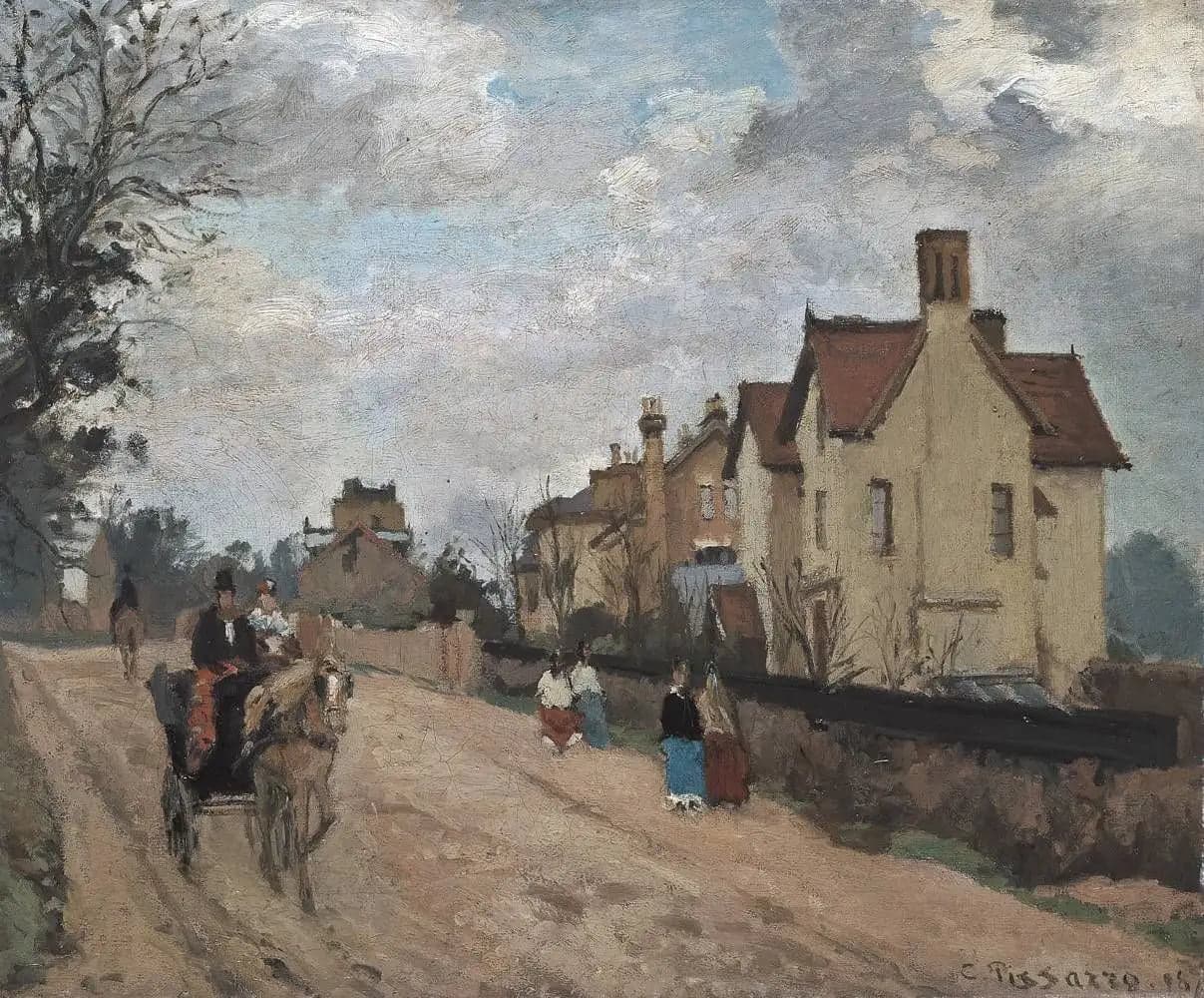
Street in Upper Norwood
- Original dimensions
- 55.6 x 45.5 cm
- Museum
- Neue Pinakothek
- Year
- 1871
Scene depicted
The painting depicts a lively street scene, where figures harmoniously blend with the typical architecture of the Victorian era. Pissarro, with his delicate technique, manages to capture the nuances of changing lights, reflecting the vitality of urban life. Every detail, from the shadows of the trees to snippets of conversations and laughter at street corners, reveals a collective story, rooted in the daily lives of city dwellers.
Historical context
Created in 1871, the painting "Rue à Upper Norwood" by Camille Pissarro is rooted in a context where the Industrial Revolution reshapes the English urban landscape. This canvas is the result of a time of upheaval, especially for the artists of the Impressionist school, who explore light and movement. Currently, this precious work is located at the Neue Pinakothek , a museum in Munich that celebrates the masterpieces of the 19th century.
Place in the artist's career
This painting stands as one of the significant milestones in Pissarro's career, representing a phase of artistic flourishing. After works such as "Le Jardin de l’aisance" and before his famous "Boulevard Montmartre, Printemps," "Rue à Upper Norwood" shows an evolution towards an increasingly free and luminous style, integrating the spontaneity of the Impressionist movement.
Anecdote
Camille Pissarro once declared: "Nature and everyday life are my greatest muses." This quote resonates deeply when considering the painting "Rue à Upper Norwood." Inspired by a morning walk through peaceful streets, he painted a suspended moment; a serene echo of a world in full transformation, transcribed in vibrant colors on the canvas .