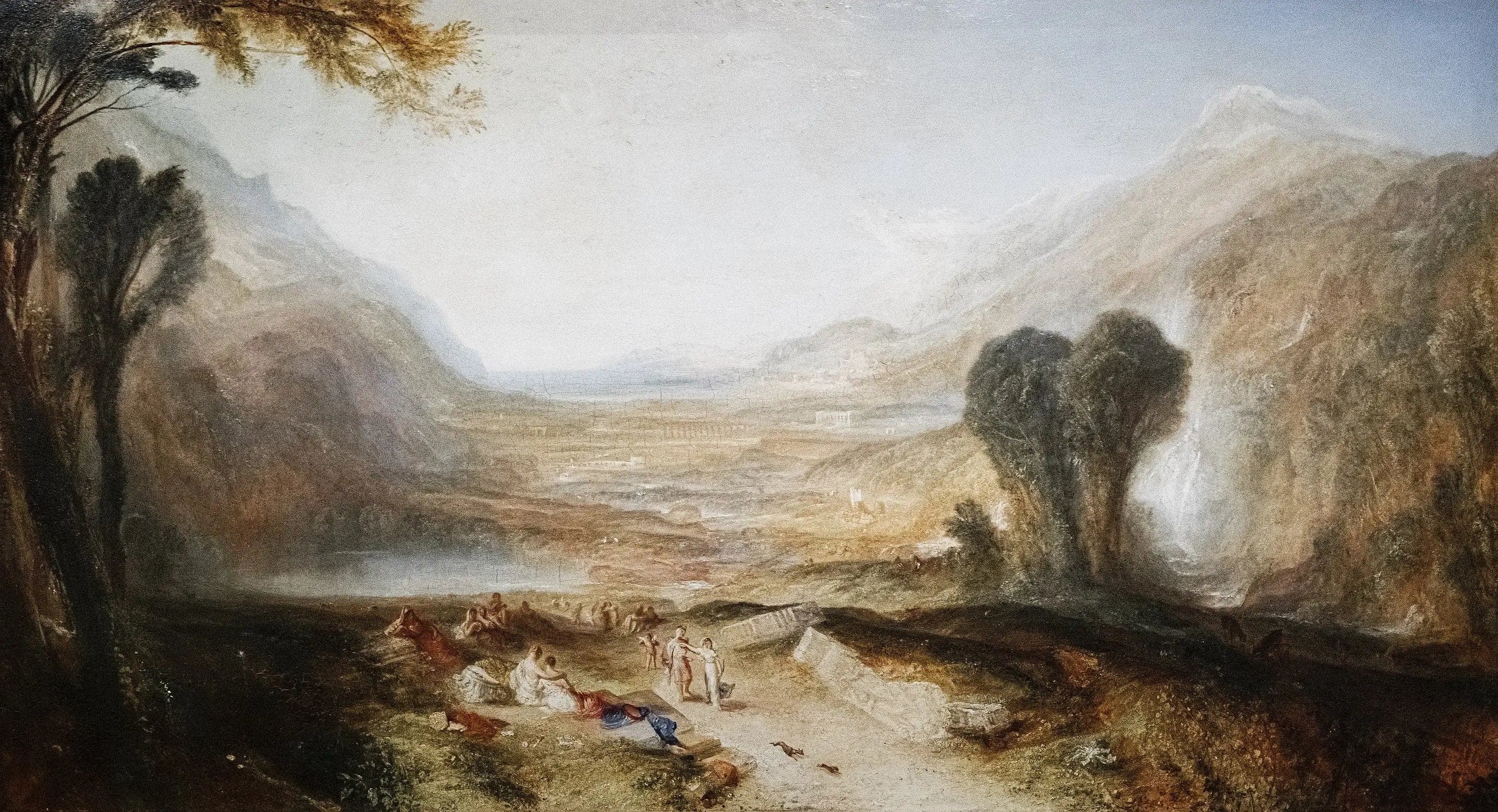
Story of Apollo and Daphne
- Original dimensions
- 109.9 x 198.8 cm
- Museum
- Tate
- Year
- 1837
Scene depicted
This canvas narrates the legendary love story between Apollo and Daphne, where passion collides with the will of nature. Daphne, fleeing love, transforms into a laurel, while Apollo, filled with despair, stretches out, revealing a scene charged with tension and beauty. This painting captures an ephemeral transition between desperate attraction and divine liberation, rendering the scene eternal.
Historical context
Created in 1837, in the vibrant city of London, this painting is emblematic of the romantic movement, which celebrates emotions and nature. Representing a key moment in classical mythology, the canvas is currently displayed at the Tate , where it continues to amaze visitors with its pictorial intensity and aesthetic depth.
Place in the artist's career
"Story of Apollo and Daphne" represents a turning point in Turner's career. Marking his evolution towards an undisputed mastery of light and color, this canvas majestically stands alongside other works such as "The Last Voyage of the Antiques" and "The Wheat Field with Crows," all depicting the artist's inner journey and his concern for the transience of beauty.
Anecdote
"Light, an ethereal dancer, intertwines with shadow." These words, ready to rise from his lips, convey the sudden inspiration that was born one spring morning. Turner, strolling along the banks of the Thames, saw the light playing on the water, thus offering him the creative impulse that would nourish his masterpiece . The canvas "Story of Apollo and Daphne" is the echo of this emotion.