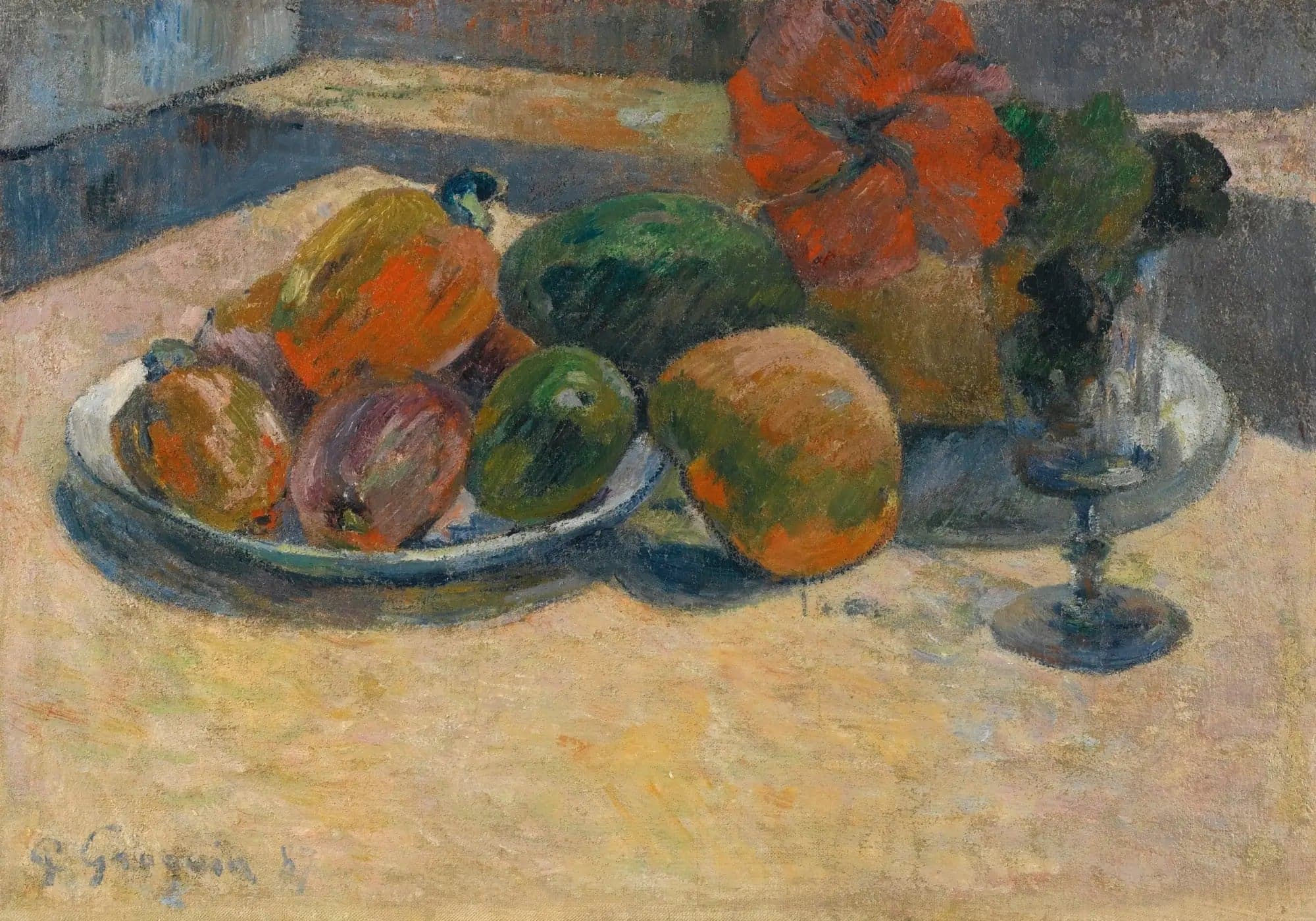
Still Life with Mangoes and Hibiscus Flower
- Original dimensions
- 47 x 32.4 cm
- Museum
- Audrey Jones Beck Building
- Year
- 1887
Scene depicted
The painting "Still Life with Mangoes and Hibiscus Flower" depicts a harmonious composition where mangoes, an emblematic fruit, coexist with the vibrant glow of hibiscus flowers. This scene invites tranquil contemplation, celebrating the beauty of nature through the shimmering hues of Gauguin's painting . The choice of elements and their arrangement reflect an interest in exoticism and escape, characteristic of his work during this period.
Historical context
Created in 1887, this work addresses the very essence of tropical beauty from the cultural haven of Pont-Aven, a small Breton town. It fits into the Nabi movement, which advocates a subjective vision of art, highlighting colors and emotions. Currently exhibited at the Audrey Jones Beck Building , this invaluable painting captures the eye with its delicate dimensions, 47 by 32.4 cm, evoking a playful and refined world, at the crossroads of Gauguin's years of intense creativity.
Place in the artist's career
This painting is part of a crucial phase in Gauguin's career, marking the transition to a bolder and more expressive style. It weaves connections with other works such as "Vision after the Sermon" and "The Flowers of Evil," illustrating the evolution of his painting technique and his relentless quest for pure color and intense emotion. Each of these pictorial works bears witness to his personal approach, moving towards an abstraction of reality.
Anecdote
“Nature is a poem that I paint, and each fruit, each flower is a stanza of this poem,” Gauguin reflected during his deep thoughts while contemplating the beauty of the islands. Imagine him, one peaceful morning, the rays of the sun filtering through the hibiscus branches, inspiring this vibrant canvas. This fleeting moment infused this painting with all its charm, like a sweet melody carried by the wind.