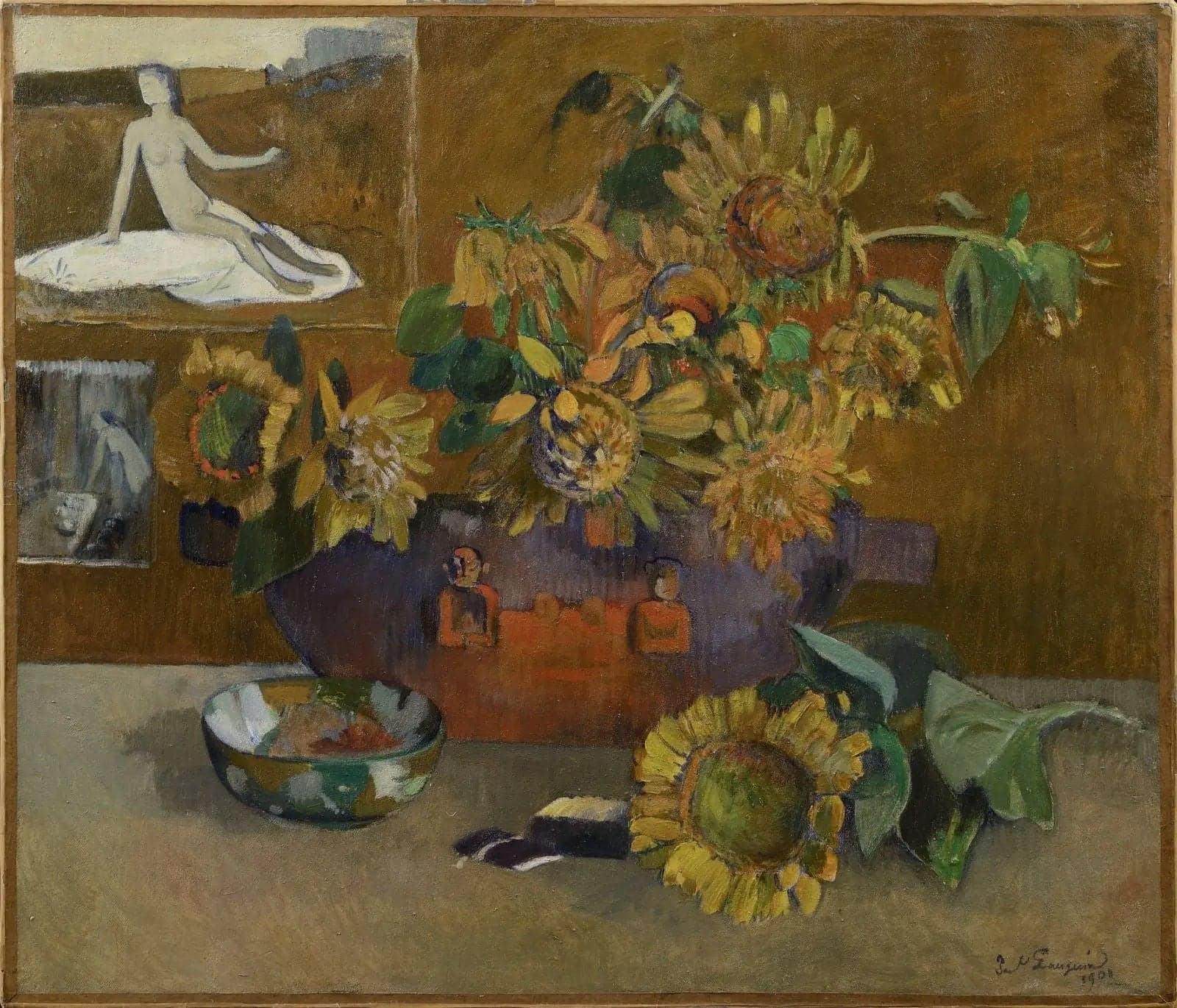
Still Life with Hope
- Original dimensions
- 65.5 x 77 cm
- Museum
- Not specified
- Year
- 1901
Scene depicted
The painting depicts with a touching delicacy a still life where the objects blend harmoniously in a silent dialogue. Each element echoes a secret memory, each shadow speaks of an ancient tale. This composition does not merely represent inanimate objects; it evokes the passage of time, the fleeting beauty of life.
Historical context
Created in 1901, the painting titled Still Life at Hope finds its source in the stylistic research of Paul Gauguin , a beacon of the Post-Impressionist movement. This canvas , which escapes the traditional canons of its time, evokes an era when art liberates itself from conventions. Today, although its exact location within a collection is not specified, its dimension of 65.5 x 77 cm makes it particularly imposing, inviting the viewer to deep contemplation.
Place in the artist's career
Still Life at Hope sits at a crossroads in Gauguin's career, between his promising beginnings and his evolution towards bolder and more symbolist works. In parallel with Vision After the Sermon and The Water Lilies , this canvas marks a stylistic maturity, where the artist exploits simplified forms to express deep emotions.
Anecdote
“Art is a journey to the soul. Every color, every stroke is a whisper of the infinite.” These words of Gauguin resonate through the painting Still Life at Hope , created on a gentle morning where soft light mingled with the scent of wilted flowers. It is this moment of serenity that inspired the artist to capture the instant in his masterpiece.
Major exhibitions
Private collections: A journey from Impressionists to Fauves